Showing posts with label Non-Fiction. Show all posts

Friday, April 5, 2019

Evicted by Matthew Desmond

Evicted: Poverty and Profit in the American City


This book is really good and it explains so much about Evictions and why they are happening at an alarming rate to our cities poor population. My brother and his girlfriend are being evicted in one month (they are evicting the whole building full of low-income residents who suffer from addiction and mental and physical disabilities to do repairs) He has lived there for over 10 years and has built a family with the other long term residents and they help and care for each other. His girlfriend has attempted suicide twice since learning of their eviction and potential homelessness and feels she needs to put down her cats since they won't be able to live on the street with her. It's heartbreaking. It's very difficult to find affordable housing in the Twin Cities area. Being evicted creates a lot of stress. Even I'm feeling the effects of the upcoming eviction and I'm not being evicted. It's so hard. This is an issue we need to create solutions for. As a teacher, I see some of my students struggling with eviction and homelessness and this changes their perceptions of worth. Read this book and educate yourself about this issue. It's so important to lower the rate of evictions in our cities, that it needs to happen NOW.

“Every condition exists,” Martin Luther King Jr. once wrote, “simply because someone profits by its existence. This economic exploitation is crystallized in the slum.” Exploitation. Now, there’s a word that has been scrubbed out of the poverty debate.”

“it is hard to argue that housing is not a fundamental human need. Decent, affordable housing should be a basic right for everybody in this country. The reason is simple: without stable shelter, everything else falls apart.”


Wednesday, May 24, 2017

The View From the Cheap Seats by Neil Gaiman

The View From the Cheap Seats. Selected Nonfiction by Neil Gaiman

Neil Gaiman is the sweetheart of librarians, book bloggers and book lovers everywhere.  In The View from the Cheap Seats, he takes his readers on a journey through his love letters to literature.  Readers will indulge on short non-fiction pieces about books and reading and libraries as well as Gaiman's thoughts about his favorite authors, book genres, movies, comics and so much more.  Get your notepad ready to write down book titles and look up authors because Gaiman will be adding to your "To Be Read" pile.  

My favorite piece called "Make Good Art" is located within the pages of this book, and I'm so thrilled to have the written text.  Squee! I show this commencement speech every year to my senior elective students around graduation day.  I will attach the youtube version for you.  It's just so good, it has its own section in the book.

Finally, The View From the Cheap Seats is a luscious 500 pages of pure enjoyment. It's like dark chocolate or fine wine or a really, really awesome book. Wait.  It is a really, really awesome book. I read it slowly to savor each piece and I read it with a highlighter because I'm a book nerd.

Now go and Make Good Art and Read Good Books.  Love ya.


Wednesday, December 28, 2016

In Winter's Kitchen by Beth Dooley

In Winter's Kitchen.
Growing Roots and Breaking Bread in the Northern Heartland
by Beth Dooley

Books and Food go together well.  In fact, they are two of my favorite things so I was thrilled to get a chance to read this book.  I adored, In Winter's Kitchen and read it slowly, one chapter at a time, to savor it.  Each chapter is about a particular food that thrives in the Midwest, like apples, wheat, potatoes, cranberries, corn, wild rice, turkey and many more.  Beth writes about her family and meets with local farmers at the farmers market and even meets them at their farms.  She talks about conventional food and organic and details the path from farm to table.  Beth connects our love of food with our love of family and love of the land. She reminded me that buying food is making a choice for a better world and a healthy body which is very important to me since I have a food allergy to corn and most canned, packaged store bought food contains some form of corn. So I have to make most of my families meals from scratch everyday.  In Winter's Kitchen has taught me so much about the food I eat and the companies I buy from.

In Winter's Kitchen is part memoir, part food history and part midwest guidebook with really good recipes tucked inside.  There is one recipe per food chapter so for example the Apples chapter has a recipe for applesauce, which I made and it was delicious. This is the first time I made homemade applesauce and it was super easy and super good.  I haven't eaten applesauce in years. Here is a picture.

This is a great book to read this winter.  Read it and then make some great food.
In Winter's Kitchen was a finalist for the Minnesota Book Award in 2016.

Here are some links to help further your reading experience.

Visit Beth at her website where you will find lots of information and delicious recipes
http://www.bethdooleyskitchen.com/

Listen to Beth on the Splendid Table podcast.
https://www.splendidtable.org/story/beth-dooley-on-the-joy-of-cooking-and-the-future-of-wheat

Gardens, Kitchens and the Great Midwest.  U of MN episode of Read This Book features Beth Dooley and another of my favorite authors Ryan Stradal.
https://youtu.be/_pLrg10D-Lc

Listen to this story from MPR which includes two recipes from the book.
http://www.mprnews.org/story/2015/11/18/books-appetites-beth-dooley

An awesome book review from Heavy Table
http://heavytable.com/in-winters-kitchen-by-beth-dooley/


Wednesday, September 23, 2015

Girl in the Woods by Aspen Matts

Girl in the Woods by Aspen Matts

In 2008, Aspen started her first year of college in a state far away from her home.  On the second day of college, she was raped. Rape is a major issue on college campuses.  Aspen reported the rape and there was a hearing.  The outcome typical and disappointing.  Aspen spiraled into a depression. She felt lost, unsupported, vulnerable and so much more.

In her depression and gloom, Aspen read John Muir's book Travels in Alaska about the Pacific Crest Trail.  Muir kept calling her name and inviting her to trek the entire trail, 2,650 miles from Mexico to Canada.  So that is what she did, she dropped out of college, enlisted the help of her parents and set off to walk in the woods for 6 months.

Aspen needed to heal and learn how to trust men and she was hoping that solitude and the long hike would make her stronger, would lead her to believe in herself and would set her on the path to her future.

This is the third memoir I have read about backpacking a trail in the United States.  I have read A Walk in the Woods and Cheryl Strayed's Wild and now Girl in the Woods.  I am a backpacker myself and have traversed the Superior Hiking Trail.  I am drawn to these types of books because I sometimes feel the call of the wild and the pull of the woods.  I would love to hike an entire trail but fear and age holds me back.  I admire Aspen Matis and Cheryl Strayed for hiking alone for miles and working through their "shit" on the Pacific Crest Trail.  

The woods is a healing force in Girl in the Woods.  This book had me turning pages as fast as I could. While reading Girl in the Woods,  the book kept invading my thoughts as I thought about the experiences of my high school students and Aspen's experience of being raped in college. The epidemic of rape on college campuses really disturbs me.

Aspen survived a rape and many trials and tribulations on her 2,650 mile hike across the United States.  She traversed extreme temperatures, snakes, deadly thirst and hunger, a vicious rumor, romance and so much more.  The Pacific Crest Trail led Aspen to believe in herself and she came to trust and love herself.  Girls in the Woods is a book about self-discovery and awakenings and it is awesome.  I loved it.

Did I mention there are full color photos inside and wonderful quotes or drawings that begin each chapter?

I am putting Girl in the Woods on my senior Non-Fiction reading list.  I wonder which lucky person will choose to read it.

You?


Disclosure:  I received this book in exchange for an honest review.


Thursday, August 27, 2015

Books, Women and The Atomic Bomb

Books, Women and The Atomic Bomb

Jeannine Hall Gailey, author of the poetry collection, The Robot Scientist's Daughter grew up in Oak Ridge Tennessee, near the nuclear facility that created the Atomic bomb.  The poetry in her book reflects her experience growing up in 1970's with a hazardous nuclear plant in her backyard.  In fact, her father was a scientist at the plant. Jeannine's poetry is environmental with a science fiction/fantasy twist.  The Robot Scientist's Daughter is creative and gives the reader a lot to think about and discuss.  So many issues are covered within the pages of this book.  Some of these poems pack a powerful dose of reality and some will scare the pants off of you.

Here is a few lines from one of my favorite poems.

Phosphorous Girl (page 57)

is the shadow in white dust you left behind.

I imagine she either went off with a jazz musician 

or followed her dream of veterinary school
somewhere in the Midwest. She dresses in discarded 
prom dresses and dances around to the Psychedelic Furs.

White phosphate hidden in her bones, she ignites
the paper caps in cap guns and snaps her fingers 
like she's striking a match.

I love this poem.  Gailey is such a master at crafting a striking, visual poem.

Shortly after I finished reading The Robot Scientist's Daughter, I heard about The Girls of Atomic City: The Untold Story of the Women Who Helped Win World War II by Denise Kiernan.  I think pairing these books for a book club or discussion would be great.  I haven't read The Girls of Atomic City yet but I'm going too.

Here is the synopsis of The Girls from Atomic City from Goodreads:

The incredible story of the young women of Oak Ridge, Tennessee, who unwittingly played a crucial role in one of the most significant moments in U.S. history.

The Tennessee town of Oak Ridge was created from scratch in 1942. One of the Manhattan Project’s secret cities, it didn’t appear on any maps until 1949, and yet at the height of World War II it was using more electricity than New York City and was home to more than 75,000 people, many of them young women recruited from small towns across the South. Their jobs were shrouded in mystery, but they were buoyed by a sense of shared purpose, close friendships—and a surplus of handsome
scientists and Army men!

But against this vibrant wartime backdrop, a darker story was unfolding. The penalty for talking about their work—even the most innocuous details—was job loss and eviction. One woman was recruited to spy on her coworkers. They all knew something big was happening at Oak Ridge, but few could piece together the true nature of their work until the bomb "Little Boy" was dropped over Hiroshima, Japan, and the secret was out. The shocking revelation: the residents of Oak Ridge were enriching uranium for the atomic bomb.

Though the young women originally believed they would leave Oak Ridge after the war, many met husbands there, made lifelong friends, and still call the seventy-year-old town home. The reverberations from their work there—work they didn’t fully understand at the time—are still being felt today. In The Girls of Atomic City, Denise Kiernan traces the astonishing story of these unsung WWII workers through interviews with dozens of surviving women and other Oak Ridge residents. Like The Immortal Life of Henrietta Lacks, this is history and science made fresh and vibrant—a beautifully told, deeply researched story that unfolds in a suspenseful and exciting way. (less)


There you have it.  These two books go together like Mac and Cheese.
Have an awesome reading day.


Saturday, January 25, 2014

The Last Lecture by Randy Pausch

The Last Lecture by Randy Pausch
Audio Book Review
Narrated by Erik Singer & Randy Pausch
4 hrs and 39 mins

Randy Pausch was a computer science professor at Carnegie Mellon when he was diagnosed with terminal pancreatic cancer.  He was married with 3 children and was looking forward to a long life of watching his children grow up.  As he neared the end of his fight with cancer, Randy decided to give his "last lecture" at Carnegie Mellon on "Really Achieving Your Childhood Dreams".

The Last Lecture series is a right of passage for professors who imagine the end of their life and the lessons they want to impart to a large audience, except for Randy didn't need to imagine coming to the end of his life.  He was already there.

These are Randy's childhood dreams:
*Being in zero gravity
*Playing in the NFL
*Authoring an article in the World Book Encyclopedia
*Being Captain Kirk
*Winning stuffed animals
*Being a Disney Imagineer

The Last Lecture is not about dying although it does figure into the book.  The Last Lecture is about truly living and following your dreams.  Randy's lecture is heart-warming and inspirational.  As a teacher, I learned some things to try in my classroom.  Randy really had me thinking a lot about my life and how to live it to the fullest degree and actually achieve my own childhood dreams.

This was a fabulous audio book.  I loved it.  The Last Lecture is meant to be auditory and listened to as a speech (or a lecture). The narrator was great and I felt like I was sitting in the audience at Carnegie Mellon.  You will laugh and you will cry and you will walk away from this book a better person for having listened to it.  I think I may need to listen to this every year.

The only difference I can see between the book and the audio version is that the book contains pictures of Randy with his family.

Randy Pausch died on July 25th, 2008.


Monday, December 30, 2013

Planet Taco by Jeffrey M. Pilcher

Planet Taco. A Global History in Mexican Food by Jeffrey M. Pilcher

Planet Taco is a scholarly look into the history of Mexican food.  Pilcher dares to ask the question, What is authentic Mexican food?  His research and travels take him into modern day Mexico and the Southwest of the United States.  Pilcher examines the Spanish conquistadors influence on Mexican food, as well as the influence of the different indigenous populations, the African slaves, and the influx of the Chinese.  Mexico doesn't seem to have a National food because their history is so varied and represented by many cultures.  Also the traditional food varies based on regional locations within Mexico and in the surrounding areas.

Planet Taco is exceptionally detailed and packed full of educational information.  Included in the book are pictures, maps and recipes.  Pilcher details the history of maize and wheat and taught me that people in the region of Mexico viewed those who ate corn tortillas as lower class (these were primarily indigenous peoples) and wheat tortilla eaters tended to be Spanish or upper class.  He details the rise of Chili Queens and Blue Corn and the American taco and so much more.

Planet Taco is a great book for those willing to put in the time and a great name for a future Mexican restaurant.  I can guarentee that you will learn a lot from reading this book.  The writing style is intellectual and studious and some people will feel like they are reading a textbook on Mexican food.  If you can put in the time to read Planet Taco, it is worth it.  This book would make an excellent companion for those traveling to Mexico for a vacation.

Caution:  This book will make you hungry for Mexican food.  I had three different Mexican style meals while reading this book.  Yum!


Saturday, December 28, 2013

Shelter by Sarah Stonich

Shelter by Sarah Stonich
A short review.

Sarah's family once owned a nice piece of property in northern Minnesota.  Her father wanted her to have the cabin experience but leased the land.  After her father died, Sarah wanted to give her son a legacy, a piece of land on a lake to call their own and to continue to the family tradition of the cabin experience.  So she head up north to Ely, Minnesota, where her ancestors are from, to look for land.  She settled on a piece of land on a small lake with tall pines and rocky cliffs.

For almost every Minnesotan, it is a wish to have a cabin on a lake.  Sarah is able to make her dream come true with a lot of muscle and hard work.  Unfortunately the state has other plans and decides to build a public road right through the middle of it.

This is the first book I have read by Sarah Stonich and I wish I would have read her fiction first.  Sarah's fiction garners exceptional acclaim and I hear nothing but great things about her as a writer.  Shelter is interesting but probably not her best book.  Stonich's writing is picturesque as she evokes the beauty of the northern Minnesotan landscape perfectly.  The storyline is like a lazy day at the lake waiting for the fish to bite.

If you have a cabin, Shelter would be a good addition for your bookshelf.


Friday, December 13, 2013

Letter From Birmingham Jail by Martin Luther King Jr.

Letter From Birmingham Jail by Martin Luther King Jr.
Audio Book Review
Read by Dion Graham
51 minutes

Marting Luther King Jr's Letter From Birmingham Jail and the Struggle That Changed a Nation

King sits in a jail arrested on Good Friday for standing up for his rights and the rights of others.  On April 12th he is smuggled a newspaper and sees the headline "A Call To Unity" written by 8 clergyman criticizing King and his methods, calling him an "Outsider".  King wrote his reply on April 16, 1963 on anything he could find to write on, the newspaper, scraps of paper and eventually a notepad.

“Injustice anywhere is a threat to justice everywhere. We are caught in an inescapable network of mutuality, tied in a single garment of destiny. Whatever affects one directly, affects all indirectly… Anyone who lives inside the United States can never be considered an outsider."  Every American should read or listen to this letter.  It is one of the most powerful essays ever written.

Dion Graham's voice lent itself to Dr King's cadence and had me imagining that I was actually listening to King recite his essay.  The power of the pen as a means for change is strongly evident in Martin Luther King's eloquent words.  MLK is truly a hero for the people.


Friday, November 29, 2013

Europe on 5 Wrong Turns a Day by Doug Mack

Europe on 5 Wrong Turns a Day; One Man, Eight Countries, One Vintage Travel Guide by Doug Mack

One day, Doug Mack is out with his mom scanning stacks of used books when he stumbles upon a worn copy of Frommer's, Europe on 5 dollars a day, written in 1963.  It just so happens that his mother used the exact same travel guide on her Grand Tour of Europe in 1967 and she was so excited that Doug found a copy of it, she was jumping up and down.

When Doug and his mom got to talking, he discovered that her trip was well documented as she had saved all her letters and postcards to his father and his return letters.  He grew up reading travel memoirs and inherited the travel bug and from his parents, so he decided to travel to Europe using Frommer's book as his guide, as a sort of experiment to see if he could travel cheaply without the use of the internet. He also wanted to document how things have changed in Europe since 1963.

Doug's European Grand Tour:

Florence, Italy:  First stop.  Full of awe and amazement. Visits Statue of David and has a museum overload.  So much art, architecture and gelato.

Paris, France:  Something's Gotta Give memorable moment.  Favorite place; Montmartre at sunset.

Amsterdam, Netherlands.  Anne Frank's house is a must see.  Beer drinking, bar hopping and people watching.  Must tour the red light district.

Next stops include;  Brussels, Berlin, Munich, Zurich, Vienna, Venice, Rome and Madrid.

Mack is a witty writer and Europe on 5 Wrong Turns a Day is well-researched and a interesting look into the history of travel, Frommer style.  It also contains some of the post war history of the European countries and cities that he visits.  It is very entertaining and I found myself getting a strong case of wanderlust and reminiscing about my travels in Europe and wanting to go back, like, right now!  Mack includes lots of travel advice and of course his musing's on tourism and traveling.

Europe on 5 Wrong Turns a Day contains some of Doug's parent's letters as well as a few pictures of his travels.  It is full of entertaining stories of getting lost and almost killed and so much more.  He includes 5 lists in the back of the book on such topics as 5 things you can actually buy for 5 dollars in Europe today.

Traveling is a life changing experience and you learn so much about yourself and the places you visit.  I have only visited two of the cities out of the eleven that Doug Mack travels to and I have to say that I learned some very interesting tidbits from Reading Europe on 5 Wrong Turns a Day and I'm hoping to go to Rome and Athens this summer.  Fingers crossed.

This is excellent book to read if you are planning a trip to Europe and even if you're just traveling via armchair, you will have a grand adventure and then get to sleep in your own bed.


Thursday, November 14, 2013

This is the Story of a Happy Marriage by Ann Patchett

This is the Story of a Happy Marriage by Ann Patchett

Ann Patchett is a writer I admire.  She has released a wonderful, well-written collection of essays about her life and her writing.  Many of the stories were previously published in magazines because before Patchett was a novelist she was a journalist and a short story writer.  Her big break came when she wrote a book review of Amy Tan's The Joy Luck Club and was hired to write non-fiction for Seventeen magazine.  She has been writing for magazines ever since, The New Yorker, Harpers, Vogue, Atlantic Monthly, The Washington Post mag and others.

Patchett included several new essays in This is the Story of a Happy Marriage as well and they are excellent.  Patchett explains her writing life and gives new writers advice in her essay "The Getaway Car, A Practical Memoir about Writing and Life."

"If you want to write, practice writing.  Practice it for hours a day, not to come up with a story you can publish, but because you long to learn how to write well, because there is something that you alone can say. Write the story, learn from it, put it away, write another story." pg 29.

Patchett's essays are deeply personal.  In "The Sacrament of Divorce", she writes about how and why she left her first husband after one year of marriage.  Her mother says that "the more lost you are, the later it got, the more you had invested in not being lost.  That's why people who are lost so often keep heading in the same direction." pg 65 And stay in unhappy marriages.

Many of her essay's revolve around her books.  In "The Best Seat in the House" Patchett discusses her love of opera and how that love was born during the time she was working on her novel, Bel Canto.  In "Fact vs. Fiction"  Patchett writes about her friendship with Lucy Grealy and both of their books, Autobiography of a Face and Truth and Beauty.  These two books should be read as companion reads.  (Incidentally, this is how I read them, back to back.  First, I  read Lucy's book and then Ann's.  I read them several years ago and recommend them to my students all the time) In her essay, "The Love Between the Two Women", conservatives try to have her book, Truth and Beauty banned from being read by the freshman class of Clemson University in South Carolina.

Ann has not forgotten that many of her readers are bibliophiles and she recommends authors and books throughout her collection.  In "The Bookstore Strikes Back" Patchett gives readers an essay on the bookstore she co-owns in Nashville called Parnassus books.  Let me just say, I need to take a road-trip to Nashville to visit this bookstore.

I'm a big fan of Ann Patchett's writing.  I have read her fiction, Bel Canto and State of Wonder, and her non-fiction, Truth and Beauty and now the collection of essays, This is the Story of a Happy Marriage.  I frankly, couldn't put this book down and did not want it to come to an end.  The reading experience was like having your best friend in the room, telling you a story about their life, over a cup of tea.  This is the Story of a Happy Marriage spoke to me and made me reexamine my life.  I love this collection of essays.  Yowsa, their good.  Ann Patchett is a writing rockstar.

I think the best way to read this book is to limit yourself to one essay a day, that way you can savor the experience.


Monday, November 11, 2013

Why Be Happy When You Could Be Normal?

Why Be Happy When You Could Be Normal?  by Jeanette Winterson

"Books, for me, are a home.  Books don't make a home-they are one, in the sense that just as you do with a door, you open a book, and you go inside.  Inside there is a different kind of time and a different kind of space.  There is warmth there too - a hearth.  I sit down with a book and I am warm.  I know that from the chilly nights on the doorstep." pg. 61

Jeanette Winterson grew up in an unhappy, abusive, and religious Pentecostal family.  She was adopted at a young age and her mother planned to mold her into a missionary of God.  Yet Jeanette heard time and time again that her parents were led to the wrong crib. Jeanette grew up with the knowledge that she never really belonged.  She didn't belong to her adoptive parents, she didn't belong to her birth parents, she didn't belong to her public school because she was so religious and she didn't belong to her church because she was a lesbian.  She spent many nights outside, alone on her doorstep.

She was kicked out of her home at the age of 16 and was homeless living in her car.  Growing up, books were forbidden in her house and so the library became a haven and she began to read every author from A to Z in English Literature.  She applied to Oxford and to her surprise got in as the "working class" experiment.  Jeanette then writes her first book, Oranges are Not the Only Fruit, when she was 24.  Some words of advice:  Read Oranges are Not the Only Fruit before you read this book.  It will make a big difference.

I once heard that if you don't deal with the trauma of your past, that the trauma will find you and make you deal with it.  Well that is what happened to Jeanette.  She sunk into a type of madness, became depressed and emerged forever changed.  When Jeanette decides to go on with her life she then makes the decision to find her birth mother.

Why Be Happy When You Could Be Normal is an amazing memoir.  It is not told in a linear fashion but it is full of life and passion.   Complex, yet simply told, Winterson bares her soul, telling her readers that she never learned how to love nor how to be loved.  Why Be Happy When You Could Be Normal is an explanation of her book, Oranges and a confession of a very painful past.  She divulges her tumultuous past with style, wit and grace all the while showing her readers, wisdom and the strength to endure.  I was so inspired and riveted to Jeanette's story and have many passages of wisdom marked in my book.  This memoir is deeply personal to Winterson and to me, as the reader.  I felt I was looking into the window of her soul.

"Nobody can feel too much, though many of us work very hard at feeling too little.
Feeling is frightening.
Well, I find it so."
Pg. 187


Wednesday, October 30, 2013

Sugarhouse by Matt Batt

Sugarhouse; Turning the Neighborhood Crack House Our Home Sweet Home by Matt Batt

Matt and Jenae live in Salt Lake City and need to buy a house fast because the lease for their apartment is up.  They have lost 2 bids already and are losing faith, when fate intervenes. Matt luckily drives by a house newly listed on the market.  It is a great street, a perfect location, everything about it seems perfect until they walk in the front door.  The smell is atrocious, who knows what is on the carpet and there is aluminum foil on the windows.  It is the neighborhoods former crack house.

Matt and Jenae buy the house and have a ton of home improvements to do in just one month.  Matt is not a handy guy, he is a writer who isn't good at much else but he signs up for some classes, makes some mistakes and eventually, with the help of his wife, fixes up the house.

Matt tells the story of his fixer upper with humor and style.  Batt is witty and insightful, with a little of bit of He-man thrown in (insert a Tim Allen grunt).  He includes the everyday family drama of his life, which I found pretty interesting, as his grandpa is quite the wild man.  In fact, I really enjoyed reading about his mom and grandparents, it added a lot of the story.

Sugarhouse is a entertaining book for those already in the home improvement stage of their lives but it is also a cautionary tale for those thinking about buying a dilapidated former crack house.  Beware or Be Brave!


Monday, October 28, 2013

Pieces of White Shell by Terry Tempest Williams

Pieces of White Shell.  A Journey to Navajoland by Terry Tempest Williams.

Terry Tempest Williams is a fierce environmentalist and is doing her best to educate readers about the connection between the people, the animals and the land.  Pieces of a White Shell delves into Terry's life as a teacher on the Navajo reservation in Utah and makes connections between Navajo culture, legend and history and Terry's own life and spiritual culture as a Mormon.

"I offer you a sampling of the Navajo voice, of my own voice and the voice of the land that moves us.  We are told a story and then we tell our own.  Each of us harbors a homeland.  The stories that are rooted there push themselves up like native grasses and crack the sidewalk." pg. 8

Pieces of a White Shell begins with Terry working as a collector as she shakes her pouch open on her desk, she wonders what stories the items she has collected tell.  Each item she collected is the name of the chapter and shapes the stories you find there.  Rocks, Sands, Seed, Turquoise, Obsidian, Coral, Pieces of a White Shell, Yucca, Feathers, Coyote Fue, Bone, Deerskin, Wool, the Storyteller and Corn Pollen.

"To tell a story you must travel inward." pg.  129

Beautiful artwork accompanies and illustrates one aspect of each chapter.  There are 13 stories or essays that meld together, told with simplicity and spirituality.  Pieces of White Shell is a testament to the beauty and harmony of the land.  It is full of the old, oral tradition stories of the Navajo people. If you love story and if you love mother earth, you will love this book.

What items do you find in nature and save in a special place?  What stories do they tell?
I collect the feathers in found in my yard and the deer antlers left in spring.  I hold rocks in my pockets and gaze at the them as the reside on my dresser.  We are all collectors of nature and stories.


Thursday, October 10, 2013

The Crossing by Jim Murphy

The Crossing. How George Washington Saved the American Revolution by Jim Murphy
The Crossing is a 80 page children's book that highlights the early battles of the American Revolution when George Washington is chosen to command the Continental army in 1775.  Washington had some military experience but the Continental army did not and they were facing a well-trained, large British army.  The British invasion begins in New York and the Continental army faced lost battles and men who deserted.  As Washington's army decreased in size and he lost or retreated from battle, he was becoming increasingly worried that he might not be able to train the army to defeat the British.

The decisive battle that turned the tide of the war, in favor of the Continental army took place after Washington crossed the Delaware river in the middle of the night.  The Crossing is an excellent historical retelling of the beginning of the American Revolution.  It is full of maps, pictures, and even gives a description of the famous painting on the cover by Emmanuel Gottlieb Leutze.

If you want to know the true story of the beginning of the American Revolution told in eloquent, simplified text you need to check out The Crossing.  The American army was truly the underdog in this war with the British and it makes you understand the significant odds that Washington was up against.  The Crossing contains an extensive travel guide to sites of the Revolution, an index, a timeline and a list of books to continue to feed your inquisitive mind.  I found the book to be informative and fascinating.  Of course, as a history teacher I am a bit biased.


Friday, August 30, 2013

Wild Boy by Mary Losure

Wild Boy.  The Real Life of the Savage of Aveyron by Mary Losure.  Illustrated by Timothy Basil Ering

In 1797, villagers from the south of France found a Wild Boy in the woods.  He was captured in 1798 and brought to the village square where he was tied up for all to see.  He escaped and was later recaptured again.

The Wild Boy couldn't talk, he was naked and had a long scar across his neck as if someone had tried to kill him and did not succeed.  He was around ten when was taken away from the woods and the nature he loved and put in a home where he could be studied by scientists.  Eventually he was sent to Paris where scientists would try to civilize him with an education and teach him to speak.

The story of Wild Boy is fascinating.  I've never heard of children surviving in the wild like this before.  Losure is a great researcher and she does a great job explaining the journey of this boy who is later called Victor.  This is Losure second book of narrative non-fiction and it reads much like a novel.  It is a fast read packed full of historical information.

Wild Boy is a beautifully crafted book.  The end pages are maps of France that outline the journey of the Wild Boy.  Each chapter begins with a quote from various sources that published information about the boy who was called the Savage of Aveyron.  Illustrator, Ering has created beautiful illustrations in black and white charcoal to enhance the story.

"To speak of the Wild Boy of Aveyon is to revive a name which no longer arouses any kind of interest; it is to recall a creature forgotten by those who merely saw him and disdained by those who have thought to pass judgement on him."  Pg. 126  Quote by Dr. Itard.  Dr. Itard is the man who thought he could teach the Wild Boy to speak and who later wrote a book about him.

Losure has crafted a version of the story that will pull at your emotions as you begin to fall in love with the Wild Boy of Aveyron.


Friday, August 23, 2013

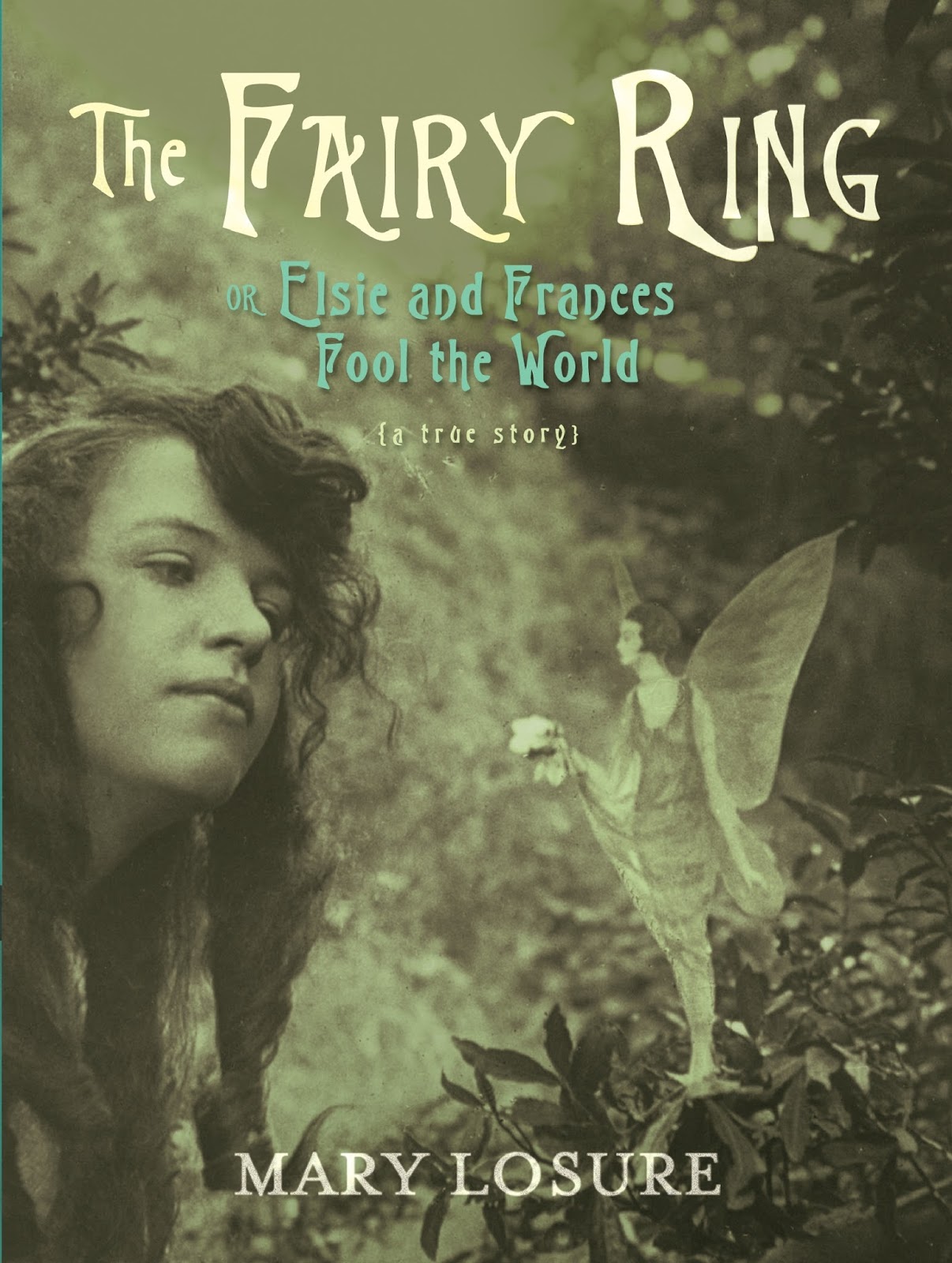
The Fairy Ring by Mary Losure

The Fairy Ring or Elsie and Frances Fool the World.  A True Story by Mary Losure

Do you believe in fairies?  I do, I do.

Frances and Elsie were cousins who lived in Cottingley, Yorkshire, England during World War I.  Frances was the youngest at age nine, and she admits to seeing fairies in the woods. Frances told her family about it and of course they didn't believe her.  Elsie was fifteen and an excellent artist so after a couple of weeks of relentless teasing by their parents, Elsie comes up with a plan to photograph the fairies.

This is the true story of two girls and a few photographs that changed their lives and fooled the world into believing in fairies.  People wanted to believe in fairies, gnomes and other creatures of the shadow world and so when these pictures surfaced, they became proof to those that believed.  Frances and Elsie's photos made the covers of magazine's and newspapers.  Some people believed, like the famous author, Sir Arthur Conan Doyle,  and other's set out to prove it was a hoax.

The Fairy Ring is a well-researched, excellent book of narrative non-fiction for young adults.  The Fairy Ring is full of primary sources like pictures, letters and quotes.  Losure even met and interviewed Elsie's son.  I had heard of the Cottingley fairies from a film called A Fairy Tale.  Reading The Fairy Ring, I learned the story from first hand personal accounts of Elsie and Frances.  Frances wrote an autobiography because she wanted her children and grandchildren to know the truth.

I loved the historical and artistic parts of the books as well.  Photography has greatly changed throughout the years.  Nowadays people can photoshop all kinds of images and creations onto the photo.  It is interesting to see how these pictures were taken, how history has changed art and photography and to see how two girls unintentionally fooled the world.

Do you believe in fairies? I do. I want to.  I do.
I have loved fairies since I was a little girl.  I dreamed I would someday fly away with Peter Pan and never grow up and get to play with fairies all day.   I have only met fairies in my imagination and in the books I read and the movies I see.  Yet I know that if I was alive when these photos were first published, I would have been a believer!

What other books have you read about the Cottingley Faires??


Tuesday, August 6, 2013

Moonbird by Philip Hoose

Moonbird.  A Year on the Wind with the Great Survivor B95 by Philip Hoose

The Moonbird, also known as B95 for the bracelet it wears around his foot, is a Rufa Red Knot shorebird.  It is called the Moonbird because scientists have estimated that B95 has flown the distance to the moon and back, an estimated 325, 000 miles in his long life.  The Rufa Red Knot is a shorebird that flies a distance of approximately 18, 000 miles per year round trip, from the southern most tip of South America to the Canadian Arctic to breed, and then back to Tierra Del Fuego.

The Rufa Red Knot species of shorebird is amazing.  They can fly for 4000-5000 miles without stopping for rest, food or water. They spend a week or two fattening up and refueling stopping about 3 times on their 9000 mile trip one way.  Their bodies are amazing and can grow a gizzard when they need it, they re-grow their feathers twice a year.

This amazing bird has been studied for about 20 years and in that time around 80 percent of the population has disappeared.  The reasons they shorebirds are dying is because the food sources on the migratory route have been declining due to human influence.  In Delaware Bay the shorebirds feed on horseshoe crab eggs but people are killing the horseshoe crabs and the birds die of starvation and can't get enough fuel to make it to the Canadian Arctic.

B95 is the one of the world's most famous birds because it is one of the oldest surviving Rufa Red Knots. This is the first time I have learned of this amazing bird because I read this amazing book by Philip Hoose.  I am now a fan and have searched to see if B95 was spotted this spring in Delaware Bay, NJ and he was!  He was seen in May of 2013.

Hoose tells the story of the Rufa Red Knots and B95 in eight chapters full of maps, pictures, and graphs.  I learned so much from this little book.  Hoose teaches the reader about each stopover place in the migratory route and it's food source and why it is important to the Red Knots.  At the end of each chapter Hoose profiles an important person/scientist/activist involved in the quest to protect this bird from extinction.  The Last chapter contains groups and ways to get involved to save the shorebirds from extinction.

Moonbird is a perfect book for bird lovers but teachers, parents, teenagers and kids would also love it.  It is informative, action-oriented and discussible.  OK, time to get out my bird book and my binoculars and look at the birds.

Thursday, July 25, 2013

The Pregnancy Project by Gaby Rodriquez

The Pregnancy Project by Gaby Rodriquez with Jenna Glatzer

Gaby Rodriquez had to complete a senior project to graduate from her Washington state high school.  In her junior year she comes up with the idea to fake a pregnancy to try and find out what stereotypes pregnant teens face as well as reasons that cause pregnant mothers to drop out of high school.  She got permission from her mom and her boyfriend as well as the principal and superintendent of her school district.

This project was going to big, Gaby just didn't realize the impact it would make and how big it would become.

Gaby is all to familiar with teen moms.  Her own mother had her first baby when she was 14 in 8th grade.  All of her sisters were teen moms and her brothers all impregnated women in their teens.  It seemed everyone expected Gaby to get pregnant too, which made this project all the more believable for her.  Gaby's project ended up changing her life and the lives of many people who surrounded her.  Her senior project made a big impact.

The Pregnancy project details Gaby Rodriquez's life growing up in a big Latino-American family living in a small in Washington.  The book covers her decision to fake her pregnancy for her senior project through when she revealed her secret to the world and the huge media hype surrounding her.

As a teacher who has pregnant teens in class as well as teenage mom and dads trying to raise a child while attending school, this story proved to be very valuable.  I feel The Pregnancy Project has given me a different perspective on what the pregnant teens go through on a daily basis.  I didn't realize all the bullying and emotional abuse they take on when they walk around school.  I also gained a better perspective in relation to the father's of these babies and what they go through and the enormous pressure they are under by their peers.  I mean I know it is hard to be a pregnant teen but I never really gave much thought to what they go through on a day to day basis or that being a pregnant teen is a isolating experience.

"I felt like a zoo animal"  Pg. 130  "I wanted to hide.  It was exhausting to feel like people were judging me all day.  I went home and cried and wished I never started this project."  Pg 131.

My own students will be creating a senior project and I am going to tell then about Gaby and her experience.  There is a lifetime movie on her project as well.  Wow this girl has guts.  Way to go Gaby!


Friday, June 14, 2013

Buzz. A Memoir by Katherine Ellison

Buzz.  A Year of Paying Attention.  A Memoir by Katherine Ellison

Katherine Ellison has ADHD and so does her oldest son, Buzz.  She is married and extremely busy, disorganized and frazzled like most ADHD moms, me included.  Buzz is 12 and is seemingly out of control.  He has no friends, he tells his mom he hates her, he constantly picks fights with his younger brother Max.  Katherine wonders where she went wrong and how she is going to survive motherhood, as Buzz moves through junior high and high school.  So she makes a plan to pay attention to paying attention for a whole year.

Katherine with her son Buzz in tow, set out to investigate ideas and solutions that will help them to reconnect and find a way to be less angry, less distracted and more in tune to their brains and how they operate.  In Buzz, A Year of Paying Attention, Ellison investigates medicine, meditation, brain scans, Neurofeedback and more.  She drives and flies with her son to many different locations to learn all they can about ADHD.  ADHD is a work in progress.  It doesn't effect any one person in exactly the same way and so what works for one person, may or may not work for another.  It is important to explore ALL your options.

As a mother who has ADD and two kids with ADHD, I found this book to be extremely valuable.  Ellison and I have a lot in common and it was helpful for me to read that some of what she goes through is just as horrible as what I go through.  Ellison made me feel validated and that it is OK to be a work in progress as a parent.

For years, I have been against medicating my kids.  I worry and as Ellison points out, a lot of parents worry about medicating their kids.  It is not a decision to take lightly. That being said, my husband has been pushing to medicate our kids.  After reading Ellison's book, I am willing to give it a try with limitations.  So we will probably take the step when school starts in the fall with a two week trial.

I wish that insurance covered more than just medication for ADHD.  I continue to dream about a day when kids go to a school that is active, where kids can control their own learning and not remain seated in a desk all day.  Where educators facilitate and not have to give test after test or can choose to do something creative over reading the paragraph and answering the questions.  Schools should be a place where all kids can succeed, not just the "good" kids.

Ellison's book is great for parents of kids with ADHD.  Please read it.  She tries a lot of different methods and solutions (some are very expensive) so we don't have to.  She rules out what doesn't work and shares all the information available in her research in the pages of Buzz.  As a parent I found it vey valuable and of course it is helping me on my own parenting journey.

My advice and Katherine Ellison's advice is to keep trying.  Never give up on your kids.
So I will continue to search for what is best for my kids and continue to read books about ADHD.