Showing posts with label 1001 Books to Read Before You Die. Show all posts

Sunday, October 21, 2012

The Stone Diaries by Carol Shields

The Stone Diaries by Carol Shields

Become a witness to Daisy Goodwill's life as she travels through the important eras of her life cycle from birth, childhood, marriage, motherhood to illness and decline and finally death.  Daisy is born to a mother who dies within minutes of giving birth.  The death of her mother causes her to feel untethered her entire life because she has lost the endearing and everlasting love of a mother.  Daisy grows up and goes through the motions of life but is consciously aware that her life is missing something.

The Stone Diaries is a fictional autobiography of Daisy Goodwill.  Daisy represents every woman as they travel through the inevitable periods of life.  Beautifully and creatively written, Daisy's story is told by people who knew her.

Can you ever really know someone?
Do you know yourself completely?

By the time we get to the end of our long life we have changed and lived multiple lives.  Five years or an important event becomes a mere hiccup in our lives.  We change, we grow, we move, we love, we hate and we die.  Life goes on with or without us.

Shields has created an original novel in style and subject.  Told from multiple perspectives and writing styles, each period in Daisy's life is interesting and important to understanding the whole person. The Stone Diaries won the Pulitzer Prize in 1995 and it is deserving.  The ending of the book is poignant and sad, like the ending of a life.  The Stone Diaries is a clear cut example of fiction mirroring life and a monument to self.

At the beginning of the book Carol Shields includes a poem from "The Grandmother's Cycle by Judith Dowing, Converse Quarterly, Autumn.  I want to include it here because it sums up the book nicely and it is beautiful.

nothing she did
or said

was quite
what she meant

but still her life
could be called a monument

shaped in a slant 
of available light

and set to the movement
of possible music


Thursday, July 26, 2012

Rebecca by Daphne Du Maurier

Rebecca by Daphne Du Maurier

The new Mrs. Max De Winter (who shall remain nameless) can't wait to begin her life as a young bride and newcomer to the renowned Manderley mansion on the Cornish coast.  When she arrives she is put off by the housekeeper Mrs. Danvers, who is still devoted to Max's deceased first wife, Rebecca.

If you visit the mansion of Manderley you will not find Rebecca there.  You will find her spirit as she roams the hall and haunts the walls.  The second Mrs. De Winter walks in Rebecca's shadow as she gets to know her husband and her surroundings.  Rebecca and Mrs. De Winter are opposites, one shy and quiet, the other talkative and vivacious.  Of course, the current wife feels she pales in comparison to the first.  Evil is lurking in unexpected places as the house tries to keep its secrets and Mrs. De Winter is being pushed to her limit.

 Reading Rebecca for the first time is a unique and satisfying experience.  The reader reaches a point in the book of shocked contentment and the book becomes an unstoppable page turner where you just aren't sure what will happen next.  De Maurier does an excellent job of setting up the mystery, the suspense and the romance and when combined with a house that is a formidable character and with the nervousness of the nameless narrator, you have a winning combination.  Rebecca will make the reader want to stay up all night reading under a blanket, holding a flashlight.

Rebecca is a timeless Gothic masterpiece.  From the first famous sentence, "Last night I dreamt I went to Manderley again.", to its last, Rebecca is unforgettable.  A book to read again and again.

Wednesday, July 18, 2012

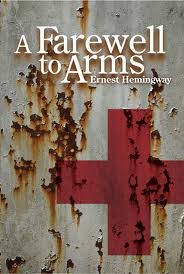
A Farewell to Arms by Ernest Hemingway

A Farewell to Arms by Ernest Hemingway

A Farewell to Arms begins in 1915 when Henry, an American, volunteers to be an ambulance driver for the Italians in World War I.    Henry is indifferent and detached from the war and survives by drinking a lot of alcohol and frequenting the local whorehouse. He eventually meets a vulnerable English nurse named Catherine and begins a primitive relationship with her. 

Henry is wounded by a mortar shell and spends months in the hospital where he consummates his relationship with Catherine.  They build an awkward relationship around his hospital room and fall in love.  Henry reluctantly returns to the war and takes part in the famous Italian Caporetto retreat and debacle.  Henry fights for his survival and those under his command.

Hemingway has created a novel with unlikeable characters who struggle to find happiness and peace during WWI.  It is a tragedy told in five parts.  It is melodramatic at times but holds to Hemingway's theory that "war is permanent" and that Nature "can have only one end".  Reading Hemingway, one must acknowledge that what isn't said in the book is just as important as what is.

A Farewell to Arms depicts WWI as difficult, depressing and impossible to escape.  Although Henry escapes the war through his romance with Catherine, it seeks to find him and forever destroy the desperate peace he has found.

The greatest part of the novel for me was the Caporetto retreat as it is well written and vivid in description.  Overall I liked the book even though I didn't particularly like the characters.  I think it is interesting to analyze Hemingway because he was obviously a great novelist for his time.  It is sometimes hard to read great books as their writing style and meaning are lost on a generation who didn't experience the truths and horrors that are represented in the pages of the book.  I do believe A Farewell to Arms is a valuable and memorable piece of literature and I am glad I read it. 


Monday, August 16, 2010

Northhanger Abbey Readalong week #4

Northhanger Abbey Readalong week #4

Pages read: 179-257
Chapters read: 24-31

This week was the dramatic conclusion of Northhanger Abbey.  It reads a bit like a soap opera minus the erotic passion and kissing.  The drive behind relationships tends to be wealth and titles.  In the end Catherine gets her man although she has to fret and worry for awhile since they are no cell phones for Henry to call.  He must actually drive his carriage to her home if he wants to speak with her.  In the end, I am not really sure why he wanted to marry her.  Maybe because she was so in love with him and that made him love her or maybe it was to anger his father and teach him a lesson.  It seems that eventually everyone in the book lives happily ever after except Isabelle and her wretched brother.

I have learned several things while reading this book.  First of all, Jane Austen book's are not as boring as I thought they were.  The second thing I learned is that I really like readalongs.  They get you to read a challenging book with other people, that you may or may not read alone and it kinda forces you to keep to a schedule and then reflect on what you read.  It is kinda like a online book chat.  So I am going to read more Austen and participate in more readalongs.

I also plan to read Radcliffe's book The Mysteries of Udolpho soon, while Northhanger is still relatively fresh in my mind.  I also want to watch the PBS film adaption of Northhanger Abbey as my reward for reading the book. I would like to thank Jennifer at Reading with Tequila for hosting the readalong.  It was fun to participate.

Saturday, August 7, 2010

Northhanger Abbey Readalong week #3

Northhanger Abbey Readalong week #3

Pages read 121-178
Chapters read 16-23

Part 2 in the book. 
I am really starting to like this book and I really love Henry Tilney, he is hilarious.  He is seriously cracking me up, as Catherine says the oddest things and he is good at jesting her.  For example, Catherine says "I have just learnt to love a hyacinth."  (who says that?) pg. 163  She takes it all in stride probably because she has no idea he is jesting which makes the reader understand the joke that the main character does not.

I read almost all this weeks required pages in one day.  The text was entertaining to me and honestly I can't believe I am liking a book by Austen.  But I am, I am liking it indeed. 

Here is what I like: 
I like that Catherine is now at the Tilney Abbey and away from John and Isabelle Thorpe. (those two characters get on my nerves, like a fly buzzing around my head) I like that Catherine is swept up in her invented mystery of the Abbey and that she totally reminds me of a modern day teenager and the drama that gets invented in their day to day lives.  I like that Austen has included plots and twists from the popular Gothic romances of her day.  I am totally going to read Radcliffe's book The Mysteries of Udolpho.  I like that Henry Tilney reads books since according to Catherine most men don't.  I like that the book is funny and the author is quite witty.  I like Henry, he is definitely my favorite character. 

Next week's drama continues with the remaining pages and persists till the harrowing end.  Stay tuned for the dramatic conclusion on Booksnob.

Monday, July 26, 2010

Moby Dick Reading Challenge - Week #6

Moby Dick Reading Challenge - Week #6

Pages read 500-625
Chapters read 105-135

I have finished reading Moby Dick! Yahoooooo! I have conquered Moby Dick and have survived the ordeal and I am so happy. I consider this a great accomplishment and my copy of Moby Dick will reside on my bookshelf as a trophy of achievement.

Melville is an absolute genius! I learned so much from this book and am so glad I undertook the difficult talk of reading it. It was worth it. The ending of Moby Dick was so good, so philosophical, so entertaining that I will definitely have to reread it. The last four chapters that is.

The book culminates in the last three chapters with the sighting of Moby Dick and the Pequod's subsequent demise. Starbuck's character made me cry with hope and denial as I so wanted him to see his wife and child and for the boat to give up the perilous fight. I loved the section about Queegueg's coffin and was overjoyed that he didn't need to use it and then the hilarious transition of the coffin being used as the ships life buoy. Genius, I say!

I bookmarked 6 quotes in the last 125 pages, more than any other section in the book.
I feel I must share them as they provoked much thought while I was reading. The last three quotes all come from The Symphony chapter.

"Well, well; I heard Ahab mutter, 'Here some one thrusts these cards into these old hands of mine; swears that I must play them, and no other.' And damn me, Ahab, but thou actest right; live in the game, and die in it!" The last sentence on page 545.

"Though but a point at best; whencesoe'er I came; whencesoe'er I go; yet while I earthly live, the queenly personality lives in me, and feels her royal rights. But war is pain, and hate is woe. Come in thy lowest form of love, and I will kneel and kiss thee; but at thy highest, come as mere supernal power; and though thou launchest navies of full-freighted worlds, there's that in here that still remains indifferent, Oh, thou clear spirit, of thy fire thou madest me, and like a true child of fire, I breathe it back to thee." Page 551

"Alike, joy and sorrow, hope and fear, seemed ground to finest dust, and powdered, for the time, in the clamped mortar of Ahab's iron soul." Page 582

"Tied up and twisted; gnarled and knotted with wrinkles; haggardly firm and unyielding; his eyes glowing like coals, that still glow in the ashes of ruin; untottering Ahab stood forth in the clearness of the morn; lifting his splintered helmet of a brow to the fair girl's forehead of heaven." Page 589

""From beneath his slouched hat Ahab dropped a tear into the sea; nor did all the Pacific contain such wealth as that one wee drop." Page 590

"But if the great sun move not of himself; but as an errand boy of heaven; nor one single star can revolve, but by some invisible power, how then can this one small heart beat; this one small brain think thoughts; unless God does that beating, does that thinking, does that living, and not I." Page 592

Moby Dick is a religious book, a time travel book though history, a tribute to whalers and the whaling life, a memoir of a man's life thus changed by the whales he hunts. It is a complex novel worthy of study.

I found this bumper sticker at www.zazzle.com
I may just have to buy it.

Thanks so Rachel at 1001 books and Book Snob Wannabe for reading this book with me. Thanks also to my friend Trudy for suggesting the blog readalong. I hope you all are relieved and happy you read it. To those who haven't read it yet, I challenge you to read it!!

Sunday, July 25, 2010

Northhanger Abbey Readalong week #1


Northhanger Abbey Read-along Week #1

Pages read 1-64
Chapters read 1-9

I joined the Northhanger Abbey Read-along sponsored by the blog
Reading with Tequila. I have only read one book by Jane Austen in my lifetime and it was difficult and slow going for me. It took me three weeks to read Sense and Sensibility and while I want to read more Jane Austen I just haven't had the urge to spend weeks on end suffering through any more of her novels by myself. So when this read-along came up, I joined it.

Northhanger Abbey is so far delightful and easier to read than Sense and Sensibility. Catherine the main character is a bit of a bore as she is quite naive but at least she is likable unlike Isabelle and John Thorpe who are completely conceited and irritating. The characters tend to lead lives that are very frivolous and concern themselves with being seen at the pump-house daily or going to dances. The characters lead lives that are so very different from my own.

What I like about Catherine and Isabelle is that they are readers of novels. Novels are new to the time-period when this book was written as a satire to the popular gothic romances of the day. I love Austen's references to real novels published at the time and feel the need to get my hands on a book by Ann Radcliffe. Many people despise the "novel" while secretly reading them with passion. It is interesting how far the novel has changed and traveled since Northhanger Abbey was written.

I am excited to continue this novel and I am looking forward to watching the film version of the book. That is my reward. I really like all the films based on Austen's books, I just wish the books flowed better for me so I could enjoy the process of reading them.

This week the plan is to read chapter 10 through 15. I hope you pick up this book and give it a try.

Monday, June 28, 2010

Moby Dick Reading Challenge - Week #2


Moby Dick Reading Challenge - Week #2

Pages read 100-195
Chapters read 19-40

The second part of this reading voyage was a bit harder than the first. I firmly believe that Moby Dick must be read with a full mind in tune to the story, not half a mind that is busy thinking about other things. I spent most of my week reading with half a mind and had to re-read a lot. My plan is to read 25 pages a night, Tuesday through Friday and it did not work this week. By Friday I only had 60 pages out of 100 read so I was far behind. I did manage to catch up on the weekend but you know it is a busy week when all you read is 60 pages out of one book!

The second part begins with lots of foreboding. As Ishmael and Queequeg are heading to board the ship, they meet up with Elijah on the street whose prophetic utterances seem to disturb Ishmael. They board the Pequod and set sail Christmas day. Ishmael goes chapter by chapter introducing the crew, from Captain Ahab, to the Chief Mate named Starbuck and many others including the harpooners. I wonder if the Starbucks coffee shop is named after the Starbuck in this story.

Ishmael narrates an extensive chapter that is an small encyclopedia of the whales known to man at the time. The whales they are hunting are the Right Whale and the Sperm Whale. This part of the book continues to set up the voyage by explaining what happens at meal times and how they spot whales from the Mast-Head. There are tons and tons of historical references and I understand most of them but unfortunately some are lost to me.

Captain Ahab shows himself on the Quarter Deck and calls "Everybody Aft". He holds a meeting on the deck to tell the crew that they are sailing and searching only for Moby Dick, the whale who took his leg. The man who sights Moby first gets a gold doubloon. So they whole crew is now involved in Ahab's maniacal revenge on a whale and Starbuck and I believe it will be their doom. Lots of foreboding happening in this section of the book.

I read the last 30 pages when I was camping and we had two big thunderstorms roll through at the same moment in the book when a squall was coming up. It was kinda eerie. So that is where I left the story, a squall is coming and so is the first sighting of Moby Dick.

Two other bloggers are reading this book in the challenge so please pay them a visit and check out their blog posts on Moby. I can't wait to see what their reading experience entailed. Thanks to Rachel at 1001 books and Book Snob Wannabe and for joining the challenge as well as all the book readers out there!

I am continuing my voyage aboard the Pequod and start to chase the big, bad, whale. Hoping to stay dry this time. This week pages to be read are 196-300. Wish me luck!

Monday, June 21, 2010

Moby Dick Reading Challenge - Week #1


Pages read: 1-99
Chapters read 1-18

Yeah, I completed the first 99 pages of Moby Dick and guess what, it wasn't that hard. I psyched myself up to believing the Great American Novel was going to be boring and difficult to read but I was wrong. In fact, it was downright entertaining. I actually laughed out loud a few times.

Call me Ishmael is the famous first sentence of Moby Dick. Ishmael is the narrator of the story who wants to be a whaler. Whale blubber is the oil of the eighteenth and nineteenth centuries and many men risk their lives to capture and kill these giant sea creatures. The first 99 pages of the book covers Ishmael's journey to Nantucket and subsequent employment on Captain Ahab's whaler called the Pequod. Along the way he meets a harpooner named QueeQueg and shares a bed with him. They become fast friends and vow to sail out on the same ship. QueeQueg is the most interesting character in the story so far.

While reading Moby Dick, I am reminded of the book, Ahab's Wife. I am so glad I read it first as it really sets me up to understand Moby Dick better. Plus, Ahab's wife and son are mentioned in chapter sixteen. If you haven't read Ahab's Wife it would be an excellent novel to read after you've finished with Moby Dick as well.

There are lots and lots of religious references in Moby Dick. The first 99 pages referenced Jonah and the Whale, Noah's Ark and quoted a few Bible passages. Either Melville was a religious man or men on whaling ships knew that life was short and risky and had a need be religious. Probably both. Ishmael states that QueeQueg is a pagan and finds important the worshiping and fasting for his idol. Melville mentions Ramadan and I am wondering if maybe QueeQueg is not a pagan but Muslim.

Here is how I accomplished my reading this week. On Tuesday through Friday I read 25 pages each day. This allowed my to have my weekends free to read another book as well as reflect on what I read in Moby Dick. I am going to try and do this again.

Two other bloggers are reading this book in the challenge so please pay them a visit and check out their blog posts on Moby. I can't wait to see what their reading experience entailed. Thanks to Rachel at 1001 books and Book Snob Wannabe and for joining the challenge as well as all the book readers out there!

Tomorrow, I set sail on the Pequod for the week and will update you on my progress next Monday. Happy Reading!

Wednesday, May 12, 2010

The Postman Always Rings Twice


The Postman Always Rings Twice by James M. Cain

Written in 1934 this short classic novel garnered lots of publicity for its mixture of sexuality and violence. The book was banned in Boston when it was originally published. Today, this book reads like a standard crime novel, fast paced, original and creative.

The expression "The Postman Always Rings Twice" is a metaphor that refers to the protagonist. The reader must infer that Frank may get away with the crime at first but fate keeps coming until you pay for what you have done. At least that's what I think it means. Just so you know, there is not a postman in the story and the titled expression is not used once.

This book is a type of story labeled Roman Noir. In other words, Roman Noir means English Gothic novel or detective novel and is also called Hard-boiled fiction. Basically these terms refer to the crime novels and authors who published in the decades of the 1920's and 30's. James M. Cain falls into this category.

The movie version, which I have not seen, stars Lana Turner and James Garfield. I am not sure if I will see it. Crime novels and movies about murder cause me to lose sleep at night but maybe since the film is a few decades old it will be OK. Hmmm, I will see if my library owns a copy.

The Postman Always Rings Twice is a book on the list: 1001 books to read before you die. It deserves a spot in the list mainly because of the controversy it caused when released as a Roman Noir novel. I love reading and learning about cultural history and this book was a pop classic of its time.