Showing posts with label Guest Post. Show all posts

Saturday, February 25, 2017

Su Smallen Guest Post + Giveaways


Su Smallen Guest Post + Giveaways

Su Smallen is the Minnesota Author in the Spotlight here on Booksnob for the month of February and she has written her first blog guest post and it is wonderful.  READ ON!


Writing to Get a Grip
by Su Smallen

Recently, I visited the Rural America Writers Center in Plainview, Minnesota, and was asked, do I imagine an audience when I write. On the formal level, I do, but without knowing who my audience will really be. On the mysterious level—why I turn and return to writing rather than cooking or sculpting—I write to a better self, the one I wish to call forward, know better, be with more often. The self that knows how this will all turn out.

Maybe that’s why it is difficult to write now. I confessed to the Rural America Writers that I have not been able to write anything coherent since the election. Sometimes I avoid the page entirely. I am scared for the self that knows the future—she is much more than my future self, or yours, this self that knows the future of the earth and her every being. I am not convinced that any of my words can save the planet. They are not political reasoning, not rule of law; they do not step down an economy of oil, cocaine, and human trafficking.

Poetry steps into an economy of notice and empathy. Maybe “an economy” is not the right fit with poetry, although the word does have in its roots “stewardship of the dwelling.” Poetry’s economy is a system that runs largely unseen and outside of the political environment, like so much else, like the cycles of carbon, hydrogen, and oxygen, like the cycles of kindness and civility. Against the annihilation of such “unseen,” my words are microscopic, meaning minuscule, and also microscopic, meaning magnifying enough to be seen.

What should be seen? Who? We are too many people; we can’t agree, can’t collectively prioritize—no one wants to be left for later. What if there is no later? Our dissonance is jamming clarity. I feel this inhibiting tension inside and out. It feels like receiving all 44,000 radio stations without a selecting tuner.

But writing microscopically, on a private scale, builds for my receiver a tuner. Word by word the tuner tunes as I trust the paper and the ink, as I trust the shapes we have agreed to for letters that make comprehensible code, scalable code. What can a particular moment hold? Or three breaths? Think what four letters can hold: hood, rain, wren, ruin, fuse, port, soil, grip.

Grip holds in its etymology “handful, sheaf.” Sheaves of paper. “Get a grip,” Deborah Keenan says
when writers stall.

I forgot how Carolyn Bizien, one of the Rural America Writers, phrased her question with exacting beauty. Do your poems hold your past for you, do they help you now, was that the gist of her question? It led to my confessing a recent rough spell, during which my poems kept a grip on me, gave my words back when I needed them, with accumulated meaning. Which is how all poems work, when they work. Poems work similarly to your patient spouse who suggests and hints and states outright a hundred times until one day you say, I have an idea, and it was hers all along.

Does poetry still matter in these times? The Rural Arts Writers assured me it is, by their words and their presence. Each writer that night had come for miles—30, 50, 60 miles—to pay attention. Their receptiveness, each attendant a tuner, assured me. As I have been writing this small essay, my breath has deepened and steadied. Unhelpful thoughts moved aside. The secret 3am bird sang and fell silent. There is more room in the room.

Thanks Su!

If you would like to win a copy of one of Su's wonderful poetry books please enter here:
Kinds of Snow Giveaway
You This Close Giveaway



Friday, February 10, 2017

Charlie Quimby Guest Post + Giveaway

Charlie Quimby Guest Post + Giveaway

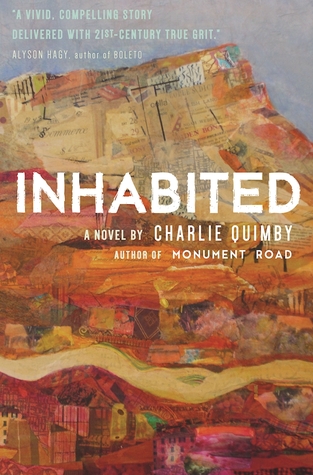
Charlie is the Minnesota Author of the month for January and he has written a guest post about homelessness.  He volunteers at a family shelter and his latest book, Inhabited, does a great job covering many of the issues surrounding homelessness.  Read on to learn more.


Since 2009 I’ve been a volunteer with organizations serving people who are unsheltered or in danger of slipping back into homelessness. In the process, I’ve met hundreds of homeless adults and children in two states.

My blog reports stories and observations from this involvement, but it’s limited in scope. To explore homelessness in a larger social context, inside minds and away from the shelters, I turned to fiction.

My novel Inhabited follows two characters whose lives become disrupted by a developer’s proposal to transform a boom-and-bust Colorado town. The plans to reclaim a forsaken riverfront dislodge a homeless camp, sending an unstable man in search of shelter and unsettling an upscale realtor’s seemingly perfect life. The book asks readers to consider the border between doing the right thing for yourself or for others.

Since Inhabited came out last fall, some readers have told me: “I’m not sure I want to read that much about homelessness.”

Maybe I shouldn’t be surprised.

The term “homelessness” pushes a shopping cart full of stereotypes. The insistent panhandler. The pathetic
bag lady. The unclean dumpster diver. The vocal paranoid.

This visible presence of the poor in our communities challenges our assumptions about society’s safety net and our own compassion and generosity.

We tend to look away from such figures on the street, and in popular entertainment, view them through the comforting filter of stereotypes, where they deliver comedy, menace or pathos in walk-on roles. They appear as anonymous victims of serial killers and wilding teens. They share scraps with pigeons and sleep in cardboard squalor. They are scary and dangerous or noble and wise. They are fallen angels or agents of redemption.

Rarely are they presented as fully realized human beings, so these stereotypes reinforce our distanced perceptions.

We know that reading literature encourages empathy. Fiction grants a safe entre to the perceptions and experiences of others and helps us appreciate people very different from ourselves.

A novel doesn’t have to be “about homelessness” to illuminate some of its many dimensions. Consider the rebels and wanderers in Huckleberry Finn, On the Road, Train Dreams, American Rust and The Unnamed. Their protagonists seek independence, fun, meaning, justice and healing—all essential pursuits of the uprooted in America.

In dystopian novels, entire populations are upended by catastrophe. Wiping out the old rules and systems dampens personal culpability for being down-and-out and casts light on the importance of society. Characters in The Road, Station Eleven and The Dog Stars must toil individually, question morality and try to reestablish community. These are also very real struggles of homeless individuals.

It can be revealing to see how people who share a place experience it very differently. A key reality of homeless life is the sense of exclusion from the mainstream, of being simultaneously untouchable, unworthy and dangerous. In Inhabited, they are compared to the invasive tamarisk that has overgrown the riverbank.

A venerable strain of American literature shows readers the economic, social, family and personal dimensions of poverty’s shadow world. Think of John Steinbeck’s The Grapes of Wrath, William Kennedy’s Ironweed, Colum McCann’s This Side of Brightness, Russell Banks’ The Lost Memory of Skin, Peter Hoffmeister’s Graphic the Valley, Jess Walter’s We Live in Water and Smith Henderson’s Fourth of July Creek.

Non-fiction offers other, safe ways into places we might fear. Big city shelters (Jonathan Kozol’s Rachel and Her Children and Nick Flynn’s Another Bullshit Night in Suck City); fragile families (the Jeannette Walls memoir The Glass Castle); mental illness on Skid Row (Steve Lopez’s The Soloist); and the conscious rejection of material culture (Mark Sundeen’s The Man Who Quit Money).

Exposure to such lives has made me less judgmental and more attuned to my privilege. Most acutely, I’m aware that what we define as a struggle between right and wrong most often plays out in choices between self and others.


Thanks Charlie!
You can visit Charlie's blog at http://greatdivide.typepad.com/

Enter to win a copy of Charlie's book, Inhabited here:  Inhabited Giveaway


Friday, December 2, 2016

Beth Dooley Guest Post + Giveaway

Beth Dooley Guest Post + Giveaway

Beth Dooley is the November, Minnesota Author in the Spotlight here on Booksnob. She is a foodie and has written several cookbooks and she has written a guest post about two books she could not live without.
Read on to find out more.

Tender: A Cook and His Vegetable Patch and Ripe: A Cook in the Orchard, by Nigel Slater (Ten Speed Press)

If my kitchen caught fire, Nigel Slater’s two volumes – Tender and Ripe – are the books I’d grab exiting the backdoor. These hefty, beautiful volumes are written in a quiet and deeply personal voice, and the prose is as sumptuous as are his recipes. The photos alone are worth the price. In each short chapter, Slater relays, in great detail, the pleasure he takes in tending the small garden of his London home. He shares memories, a little food history, and provides practical information about planting and harvesting the vegetables and fruits. As he moves into the kitchen, his advice is whimsical and engaging with suggestions for flavor pairings, quick preparation tips, and simple, homey recipes.
Never self-righteous or preachy, Slater’s love of our earth’s bounty and it’s benefit to our health and environmental shine through. His ascetic is comforting and inspiring and these pages transport me to
a gentler time and more civilized place.

If you would like to enter to win a copy of Beth's book, In Winter's Kitchen please click here:

In Winter's Kitchen

Good Luck!

Thanks Beth!

Sunday, May 22, 2016

Pamela Carter Joern Guest Post + Giveaway


Pamela Carter Joern Guest Post + Giveaway

Pamela is the Minnesota Author in the Spotlight here on Booksnob for the month of May. She has written a guest post about a question one of her readers asked and it will make you think about what a reader brings to the stories they read.  Read on.

Written by Pamela Carter Joern

One of the best things about writing is the convergence of the writer’s world and the reader’s experience. I was reminded of this last Fall when I spoke at Anoka-Ramsey Community College as part of their Two Rivers Reading Series. The students had read my story collection, In Reach, and after our discussion a young man named Don came up to the podium to ask me a question. Each student had been asked to write about one of the stories, and Don had chosen “Solitary Confinements,” a story about a gay man whose father doesn’t accept him, his mother who is suffering from Alzheimer’s, and a neighbor who sleeps in an iron lung every night. The main character, Ted, works out his frustrations by gardening, and Don asked if I had chosen the flowers in the story because of their symbolism.
“I’m a gardener,” I said. “I know which flowers would be in season and available in western Nebraska, but that’s about it.”
Don seemed disappointed. “I was sure you chose them on purpose. Because geraniums usually mean someone is a fool, but red geraniums mean comfort, and Ted places those red geraniums on Flora’s steps when he leaves town.”
“That’s a lovely thought,” I said. “But I wasn’t aware of the significance of the flowers. I wish I had been.”
Later that day, Don wrote me this email:
“I wanted to say a bit more . . . The reason I thought so much about the flowers was not just the red geraniums, but also the tulips and petunias. Tulips mean love and petunias mean hope. So when Ted pulled tulips from his parents' garden, I thought you were saying the love between he and his parents had died. When he planted petunias, he was saying he hopes to reconnect with them. It made sense because his parents don't like him being gay, yet Ted talked throughout the story of how he wanted his parents to be in his life. I'm really surprised everything was a coincidence because it just fit so perfectly.”
I wrote back to Don and thanked him for his insights and his persistence. He couldn’t believe I didn’t purposely layer my story with this symbolism. This is the beauty of literature! He understood the intention of my story, but he also brought to it his own rich experience, deepening the meaning beyond even what I knew. Now, when I think of Ted and Flora, I also think of Don and the added resonance he brought to the flowers.

If you would like to win a copy of Pamela's book of short stories, In Reach, please click here:  In Reach Giveaway


Saturday, April 23, 2016

Kirsten Dierking Guest Post + Giveaways

Kirsten Dierking Guest Post + Giveaways

Kirsten Dierking is the April, Minnesota Author and Poet in the spotlight here on BookSnob and she has just written a lovely post for National Poetry month on ten poems she loves.  I love this guest post and hope you do too.  What are some of your favorite poems?

For National Poetry Month, I thought I would just share ten poems I love.  I have to say, this made me want to do many lists!  (Ten Minnesota Poems I Love, Ten Animal Poems I Love, Ten Poems with Humor I Love, etc.)

1.  Raymond Carver, What the Doctor Said
That waterfall, where a moment of grace and beauty and something mystical beyond corporeal life enters this poem. The way the terrible tragedy of the news is discussed in casual language and with common courtesy - the way we mostly deal with the terrible news in life.

2. Linda Pastan, The Death of a Parent
"suddenly/there is nobody/left standing between you/ and the world"

3. Louis Jenkins, Rock Collecting
I think of the idea of this deceptively simple poem often - the burden of loving something, the freedom of few attachments.

4. John Berryman, #29 from 77 Dream Songs
The first four lines are the best description of depression (or perhaps great loss, grief or sorrow) that I have ever read.

5. Pablo Neruda, Sonnet XVII
An intense love poem about real love:  "I love you simply without problems or pride"

6. Mark Doty, New Dog
"So after I drive
to Jimi and Tony’s
in the Village and they
meet me at the door and say,
We can’t go through with it,

we can’t give up our dog"
~~~
What we love and what we have to give up in our lives - and how we find some way to bear that (dogs help).

7. Jim Moore, It Is Not The Fact That I Will Die That I Mind
That our fierce love for our own, particular world will be lost with us.

8. James Wright, A Blessing
Those last three lines - Wright's ability to convey a transcendent moment of grace in simple words - so very, very difficult to do.

9 . Lucille Clifton Homage to my Hips
Love the empowering tone of this poem, and the humor.

10. Robert Frost, Stopping by Woods on a Snowy Evening
The lovely moment of stillness between obligations, the being alone - but not quite (the horse is there), the sound of the harness bells in those snowy woods. That what is dark and deep is lovely.

Thanks Kirsten.

If you would like to win copies of Kirsten's poetry books click here:

Go forth and read poetry!


Friday, August 21, 2015

Rebecca Hahn Guest Post + Giveaway

Rebecca Hahn Guest Post

Rebecca Hahn is the Minnesota Author in the Spotlight here on Booksnob for the lovely month of August and she has written a guest post on the "other" books, the books she didn't actually write.  She thought she was writing a trilogy and it didn't happen.  Read on to find out why and to gain some insight into the some of the characters in her book, The Shadow Behind the Stars.


One Book out of Three: Structuring The Shadow Behind the Stars

It’s a common trope in fantasy for the main characters to be fighting to keep the world from ending (see Buffy the Vampire Slayer, all the seasons, for example). As I was writing my latest book, The Shadow Behind the Stars, I started to wonder what would happen if the main character, the one you were supposed to sympathize with, was the person who had the power and the motive to end the world.

The Shadow Behind the Stars is narrated by Chloe, the youngest of the three Greek Fates. For quite a while, I was sure that I was writing a trilogy: each of the three books would be narrated by a different sister Fate. The story would build toward the end of the world, and rather than fighting against the destruction of everything, the sisters would themselves become the apocalyptic threat—and nobody else would be powerful enough to stop them.

I did go so far as to write bits and pieces of the last two books, in the middle-aged sister Serena’s and eldest sister Xinot’s voices. Some of those bits I ended up using in The Shadow Behind the Stars after transferring them into Chloe’s voice. But some never did become part of the story, and I thought I’d give you just a taste of what I ended up throwing out here. This is a bit from Serena’s story, in her voice:

I watched the children playing. They were mine, though they didn’t know it. I could see it shining whenever I looked at them, the bright potential. They were as unformed as dunes of sand, blowing, shifting from one shape to another. Oh, how I loved them.

And here’s a bit from the unwritten third book, in eldest sister Xinot’s voice:

I am something different. I am closer to the heart of what we do. I am farther from mortal everyday life, and I am less concerned with time or causation. The world will turn. What must be, will be. We spin at the center of it all, and the little things we choose can make no more difference than the smallest of eddies in a great rolling sea.

After deciding that Serena’s and Xinto’s stories weren’t compelling enough to merit their own books, I next tried writing a sequel from the perspective of a young mortal boy and girl who become involved with the Fates, a star-crossed lovers sort of story:

My name is Philomena. When I was seven, I stopped the Fates along the road and asked them for a prophecy.
Yes, those Fates. I know their names now, but I’m not sure I should tell you. They’re quite secretive about things like that. They didn’t tell me their names when I stopped them that first time. That was the second time, when they came to my bedroom window and asked me to help them steal a goat.

In the end, though, there was no second or third book, as the epic storyline about the end of the world got moved up into The Shadow Behind the Stars. I think it works better that way—the thematic and the character arcs are fuller and stronger—and if I ever do write another book about Chloe and her sisters, I’ll need to move into a brand new storyline with new ideas . . . which would probably be much more interesting to write (and read) anyway!

Thanks Rebecca

If you would like to win a copy of Rebecca's book The Shadow behind the Stars, please click here:


Sunday, July 26, 2015

Pat Schmatz Guest Post & Giveaway

Pat Schmatz Guest Post & Giveaway

Pat is the July, Minnesota Author in the Spotlight here on Booksnob and she has written a guest post on how a book percolates and is eventually formed on the written page call Dream Horses/Dream Stories.  Do you ever write down your dreams or envision a story?  I know I do and getting it correctly on paper is difficult.  Read on to find out more from Pat.


Dream Horses/Dream Stories

For me, a book starts with a small, foggy notion. A character maybe, or a situation or a setting. I sit very still and watch. I coax the notion to draw nearer. I sketch what I see. I color. I write bits of poems, snippets of dialogue. I go on long walks, inviting the notion to float near me. It grows and begins to take form, to have voice. It surrounds me. Eventually I begin to see movement in the mist. Smells drift in. I hear music. I feel the characters’ breath on the back of my neck. The essence of the story reveals itself to me.

Suddenly, the idea is huge and it’s beautiful. Not just beautiful. It’s profound and panoramic, it’s breathtaking and world-changing. It is the best story ever in the world. I’m in love with the characters. The story breaks my heart and fills me with hope and magic and visions for peace, compassion, understanding, beauty and courage.

Then, I begin to write the first draft. The work is difficult. It’s tedious. And more than anything, it is disappointing.

The process reminds me of Ken McLaughlin in Mary O’Hara’s 1941 novel My Friend Flicka. Ken was a daydreamer who lived on a ranch in Wyoming. More than anything, he wanted a colt. Thousands of mystical dream-colts gamboled through his head.

Then, his father told him that from all of the colts on the ranch, he could choose one of his very own. He chose Flicka and he loved her – but he also experienced the loss of all of those dream colts. From the moment he chose, he was left with a singular flesh-and-blood reality.

That’s what happens when I begin to pin my beautiful new story down into words. My magnificent dream is slowly whittled down to the vocabulary and sentence structure and plot and craft. At best, I can capture only a shadow of the story in my head. The colors are nowhere near as bright. The music is muted.

I work hard at craft, trying to use the limited tools of written language to the very best of my ability. The first draft is always a huge disappointment, but all is not lost yet – I have hopes that drafts two, three, and four will bring in more of that magic. But at some point, I realize that the entire vision is beyond me. I will have to settle for paper-and-ink reality. Friends and critique partners, editor and agent help me fine-tune, but it’s sad to me, that they can’t see the story in my head. They can only see what I manage to put on paper.

When the book is finally done, I love it as Ken loves his horse. But those dream colts? They slip into the distant mist like Ken’s, lost to me forever. Until I start the next book.

Thanks Pat.

To win a copy of Pat's book BlueFish and an ARC of her newest book Lizard Radio, please enter here:  BlueFish and Lizard Radio Giveaway


Wednesday, May 20, 2015

Benjamin Percy Guest Post + Giveaway

Benjamin Percy Guest Post + Giveaway

Benjamin Percy is the Minnesota Author in the Spotlight for the month of May and he has written a guest post about The Dead Lands and its origins. If you love History ( ah, you should love history) then this post will interest you.  I think I need to travel to Oregon someday and visit the places Percy talks about in his post.  In a unrelated note, I'm traveling to Berlin tomorrow.  Happy Dance.

The Rest is History
Benjamin Percy

I always wanted to write about Lewis and Clark. I grew up at the end of the trail—Oregon—where Fort Clatsop is, where the bicentennial was held, where so many statues and landmarks note the heroism and travails of the expedition.

My mother is a hobby historian. When I turned twelve, she gave me their journals as a gift, inscribed with the message “Seek adventure.” And every time we headed off to some canyon or mountainside on a weekend adventure—camping, hiking, fishing, hunting—she would make sure we paused to recognize this as the place where Lewis sneezed or Sacagawea voted or Clark shot a bear or whatever.

It was ingrained in me. The belief that theirs was the greatest adventure story in American history.

Initially I thought I would write a nonfiction account of their journey—by recreating it. I would paddle, pedal, hike my way from St. Louis to Astoria. And bring different people—friends, family—with me along the way.

A publisher caught wind of this and bid on the project as part of a deal for my previous novel, Red Moon. For whatever reason, I had neglected to mention the idea to my wife. We sat down and figured out how long the mission would take and how much it would cost and she very reasonably said, “That ain’t happening.”

So I decided to make some stuff up instead. I debated the possibility of a historical novel, but that’s been done and Ezra Pound’s charge to the writer is “Make it new.”

I made it new. Post-apocalyptic Lewis and Clark. Lewis and Clark 2.0.

Think about it for a moment. Here is this vast territory—Louisiana—that everyone coveted: Britain, France, Russia, America. Napoleon sold it for fifteen million to Jefferson and in doing so we doubled the size of this country. No one knew what was out there. (Correction: no white people knew what was out there.) Some believed wooly mammoths might roam the plains and mountains. It was the equivalent of blasting off for the moon.

So here they are hoping to reunite the states, build a new American. A post-apocalyptic wasteland felt like the right move, the best way to make the material new and relevant and perilous once more, not so far off from the way the expedition must have felt when setting off into untold wonders and horrors.

Benjamin Percy’s new novel is the The Dead Lands. He writes the Green Arrow series for DC Comics. His original television series Black Gold – a modern-day western set in the North Dakota oil fields – is in development with Starz. He is a contributing editor at Esquire. Follow him on Twitter at Benjamin_Percy and learn more about him at www.benjaminpercy.com

If you would like to win a copy of Benjamin Percy's book The Dead Lands, please click here:  The Dead Lands Giveaway


Thursday, April 23, 2015

Pete Hautman Guest Post + Giveaway


Pete Hautman Guest Post + Giveaway

Pete is the Minnesota April Author in the Spotlight here on BookSnob and he has written a guest post on Faith, fences, friendship and so much more. Read on for a little back story on his latest book Eden West.


The Fence Around the Water Tower

By Pete Hautman


Here's something you should know about vengeance demons: We don't group with the "sorry." We prefer "Oh God, please stop hitting me with my own rib bones." —Anya, from Buffy the Vampire Slayer.

So…I wrote this book about a kid who grows up in a cult—

Oh God, another cult book. Please stop!

Hey, when I started writing Eden West back in 2002, “cult books” were not yet a “thing” in YA literature. Now it seems I’m late to the party. But when I started it I didn’t know that the book would be about religion.

Oh God, please stop! Don’t make me read about religion!

Sigh…such is the general consensus. The topic of religion is divisive, emotional, and far too dangerous for tender young minds. Unless of course they are reading from the point-of-view of their Parentally Approved faiths. That’s why so few YA novels mention religion at all. Best to pretend it doesn’t exist—just as most of us do, ninety-five percent of the time.

Twelve years ago I wrote a book called Godless about a boy who starts his own religion worshipping the town water tower. The reviews were great, but nobody was buying it. If Godless hadn’t won the National Book Award a few months later, it would have gone out of print. Religion does not sell books. (Well, except for the Bible.)

But whether or not we choose to acknowledge religion in our reading and writing, it’s kind of a big deal. Teens in particular struggle with it, especially when they are thrown into contact with other teens whose worldview is radically different. For most teens, dealing with questions of faith is an important part of coming of age.

While writing Godless I was thinking about how our beliefs divide and unite us, how they both create community, and how they separate us from others. I was thinking about fences.

Eden West began as a story about a chain link fence with a boy on one side and a girl on the other. I love fences, from the Great Wall of China to the twelve-inch rabbit fence protecting my Swiss chard. I like the geometry of them, the simplicity, the statement, the opportunities for self-indulgent metaphor.

On one side of the fence is an apocalyptic cult known as the Grace, and a boy named Jacob who knows no other life. On the other side is present-day Montana and a girl named Lynna. I found myself writing yet another book about a teen coming in conflict with his faith.

Eden West became a sort of inside-out version of Godless. Godless was about a boy whose own thoughts drive a wedge between himself and his faith. In Eden West, the driving force comes from outside: a girl, a wolf, the World. Naturally there is love, lust, betrayal, revelation, and redemption, because all books should have these things.

So, yeah, I wrote another book about religion. But really it’s about people. And fences.


Thanks Pete!

If you would like to win a copy of Pete's latest book, Eden West, please enter here:  Eden West Giveaway


Tuesday, February 24, 2015

Allen Eskens Guest Post + Giveaway

Allen Eskens Guest Post + Giveaway

Allen Eskens is the Minnesota Author in the Spotlight here on BookSnob for the month of February and he recently visited the high school I teach at in Minneapolis to talk to students.  He wrote his guest post about a question he didn't expect.  Allen's book, The Life We Bury is taking South High School by storm.  I see students and staff reading it everywhere.  Read on.


A question I didn’t expect.

I recently did a presentation at Minneapolis South High School and a young lady asked a question that caught me off guard. I’d given my talk about how I came to write my novel The Life We Bury, and I was taking questions when this bright young woman asked “If I could go back in time and talk to myself and give myself advise, how old would I be. I’d come prepared to answer questions about my writing process or what it’s like to publish a novel, but this question was definitely one of those outside-the-box questions.

I didn’t have time to give that question the hours of thought it deserved.  I shot from the cuff and said sixth grade. And now, after giving it some thought, I believe I got it right.

 I remember being a fairly self-confident kid up until I got into sixth grade. I used to do the readings at my church, walk fearlessly among my peers, and I even had a part in the school play. But then sixth grade came along and something happened. I wish I could tell you what that was, but I can’t. No crippling trauma. No loss of a loved one. No single incident that would explain the change. I just
changed.

I developed a form of stage fright that shrunk my world. I became unable to speak in front of people. I gaped like a freshly caught perch whenever a teacher would call upon me to answer a question in class.

For the next three years I began a slow withdrawal from life. I quit all of my extra-curricular activities. No more football, wrestling or drama club. I became introverted and awkward. Looking back now, I see that my slide was born of a complete loss of confidence.  Doubt gripped me in every aspect of my life. By the time I started high school, I had pledged that I would keep my head down and do the very minimum necessary to graduate.

But then, on a dare, my best friend and I tried out for the school play. I was terrified and expected that I’d freeze on stage. But to my relief, I made it through—and had fun in the process. Over the next four years, I threw myself into theater and by the time I graduated I was a completely different person. I regained my self-confidence, and I’ve been grabbing life by the throat ever since.

Back then, I came close to skidding down a very different path in my life. But now I am a successful attorney with a novel that is a finalist for the Edgar Allen Poe Award and a Minnesota Book Award. When I spoke to the kids at South, I wanted tell them the things I wish I could have said to my sixth-
grade self. Don’t let self-doubt be the deciding factor in what path you take. Challenge yourselves and you’ll be surprised what you can accomplish.

Allen Eskens

Author of The Life We Bury

Thanks Allen.  If you would like to win a copy of Allen's book, please enter here:  The Life We Bury Giveaway


Friday, February 13, 2015

Rebecca Adams Wright Guest Post

Rebecca Adams Wright Guest Post

Do you like to read short stories?  I hope so. I read a short story every Saturday and enjoy them immensely.  Give them a try. Please welcome short story author, Rebecca Adams Wright to BookSnob.


Book Snob Guest Post: Location, Location, Location
by Rebecca Adams Wright

I’m here to talk a bit about my new collection, The Thing About Great White Sharks, specifically the settings that inspired many of the stories.  I hope you will indulge me, as I personally find that listening to authors talk about their real-world influences can sometimes be a wonderful way to connect with not only their work, but also with the places that work describes.

The Thing About Great White Sharks is a love letter to many genres and many locations.  There are science fiction stories set on far-future Earths and man-made space stations, and these, of course, were influenced more by powerful descriptions I have read about space than by places I have actually been. But other works, even those set on alien planets, can trace their roots closer to home.  My story “Barnstormers,” concerned with a group of stunt fliers putting on an extraterrestrial desert airshow, is intimately rooted in the dry heat, dusty orange landscape, and spicy scents of the land in Western Arizona.  The struggle to survive in a beautiful but inhospitable environment was a thematic element I wanted to braid throughout the story, and that particular setting felt about perfect.

Other major influences on the book were trips I made to England and Ireland in 2008 and 2010. These were my first visits to countries that shaped so much of Western literature, thought, and culture, and the areas I visited—London, Bath, Yorkshire, Dublin, Kilkenny, the Dingle Peninsula, and the Ring of Kerry—made a distinct impression on me.  I found myself fixated on the vibrant pastoral patchwork of both rural England and Ireland.  Eventually these shaggy, rock-walled fields became the backdrop for “Keeper of the Glass,” my fantasy tale of growing up in wartime.  In “The White Chalk Road,” a story split settings in America and Great Britain, my dreaming protagonist walks along the crest of a hill inspired by the land around the Avebury stone circles.

Several times in the years that I was writing Sharks details of previously-visited places filtered into the prose and shaped the way the narrative took form.   “Keeper of the Glass” is an example of this filtering at work.   In September of 2008, while touring York, I learned that during WWII York Minster sent a number of its famous stained glass panels off to homes in the English countryside in an effort to protect the art from Nazi bombs.  What a fact!  The idea of all that precious medieval history tucked away in cellars and garden sheds was so interesting to me that “Keeper” ended up becoming, in part, about what would happen if those vulnerable pieces of glass could manifest some protection of their own.

Some stories found their inspiration closer to home.  “Storybag” follows a traveling salesman around a 1960’s version of the small town where I currently live.  In “The Space We Share,” my child protagonist roams the echoing, tiled halls of a junior high that is layered together from memories of all the schools I ever attended.  He is looking for a ghost, and it seemed appropriate that his world be shaped by the ghosts of my own experience.

It’s so important as an author to be able to make things up.  But I was reminded while writing this collection that the best inventions germinate from seeds of real-life observation.   The Thing About
Great White Sharks is a better book for all the different places that have come to populate it, and the fabric of its invented worlds is richer by being woven from threads of real experience.

Thanks Rebecca!


Sunday, December 21, 2014

Heather A. Slomski Guest Post + Giveaway


Heather A. Slomski Guest Post + Giveaway

Heather Slomski is December's, Minnesota Author in the Spotlight here on BookSnob and she has written a guest post on how the weather influences her writing and is portrayed in her stories.  As I look out the window,  it is snowing and huge white flakes are falling on the brown ground.  Weather definitely affects my mood and influences authors and stories.  Read on.


On Weather

Today, after I put my toddler down for a nap, I looked out at the cold, gray afternoon and was reminded of something that, surprisingly, I only recently realized about my writing: my loyalty to the weather.

I am a fiction writer, and while my writing is certainly at times influenced by my life—the people in it, the things that have happened to me or to the people that I know—when I sit down to write, these people and events detach themselves from reality and become fiction. The more a story derives from reality, it seems, the more fictionalization it undergoes. This is not a conscious decision to “hide” the truth, but rather something I do naturally. I write fiction, not nonfiction. Therefore, if I’m writing about something that stems from real life, I have to give this “something” an imaginative life if I am to have any interest in writing about it. More precisely, the
imaginative life of the something real is what inspires me to write about it in the first place. One aspect of my work that I never imagine, however, is the weather.

Every story I’ve ever written (and I’m certain every story that I will ever write) takes place at the time of year when I wrote it. For example, my story titled “Iris and the Inevitable Sorrow, or The Knock at the Door” takes place on and around Valentine’s Day, and I wrote this story over the course of one particular February. “Before the Story Ends” begins in late autumn but takes place primarily between mid-December and New Year’s Day, and I started this story one New Year’s Day and finished the first draft by the end of January. And to give one last example, my short-short titled “Rescue” takes place at the end of summer, and I wrote this piece one August.

I’ve always been aware that setting is important to my work; it is often my main reason for writing a
story—to spend time in an imagined place or to return to a place I’ve left. Weather is an element of setting, so I suppose the connection I’m making here is rather obvious, but to me it’s a bit intriguing, because if I fictionalize almost everything else in my work, why not the weather?

I suppose the reason has a lot to do with mood. The weather outside influences my mood, and that mood (and weather) ends up seeping into my work. While it would make sense that I might want to write a summer story in the dead of winter in order to escape the cold and to “be” in a summer climate, or to escape the heat of summer by writing a story about a snowstorm, I’m just never in a summer mood in the winter or a winter mood in the summer. The moods I create in my stories stem from the moods I’m in while writing, and because my moods are influenced by weather, I’ve discovered that I’m a very seasonal writer.

By Heather A. Slomski

Thanks Heather!  If you would like to win a copy of Heather's Award winning book of short stories, The Lovers Set Down Their Spoons, please enter here:  The Lovers Set Down Their Spoons Giveaway

Happy Holidays!


Sunday, October 19, 2014

Alison McGhee Guest Post + Giveaway

Alison McGhee Guest Post + Giveaway

Alison McGhee is the October Author in the Spotlight here on Booksnob's Blog and she has written a guest post on her "Tiny House" in Vermont where she writes and uses her time to get creative.  This is really interesting to me as I have never heard of the Tiny House movement.  Super cool!

Guest Post

I'm writing this guest blog from the kitchen of a Tiny House in Vermont, where I live part-time. "Tiny House" is in caps because living in micro-houses has become something of a movement these days, wherein a conscious decision is made to (mightily) pare down one's belongings and move into a 100-500 square foot house, sometimes on wheels, sometimes not.

I'm not really a Tiny Houser, because I still have a regular-sized house in Minneapolis. But this tiny house on a hill in Vermont is one that friends and I have built over many years, little by little. The original, 200 square foot cabin (one room with a sleeping loft) was a kit I bought off eBay and lived in (no plumbing, an outhouse) until just recently, when we milled some trees from the land and doubled the size. Now there's a sink and a shower and a camping toilet, and we're done.

What does this tiny house have to do with writing? For me, a whole lot. Since I was a child, writing has been a way to translate the experience of living into art, or, if not art, something that transcends the actual experience of living.

There is so much suffering in the world. And there is also so much wonder and wildness and curiosity. When I was little I felt as if I couldn't hold all that emotion inside - I had to turn it into something outside of myself as a way of both absorbing and filtering life. I still feel that way. Maybe
most artists do, whatever the form they choose for their art.

So, back to the tiny house. A small space with fewer things means fewer hours spent cleaning and maintaining and earning the money to support that space and those things and more time to experience life and the translation of it into art. This isn't a new idea --hello, monks and nuns and zen seekers-- but in mid-life, which is where I am, there is nothing more precious than time.

My friend Julie said once that "writing is my only church." Yes.

Thanks Alison!

If you would like to win a copy of Alison McGhee's new book Star Bright, A Christmas Story, please click here:  Star Bright Giveaway