Showing posts with label MN author. Show all posts

Thursday, April 2, 2020

Poem in my post: The First Three Stanzas of My Body by Laura Kozy Lanik

Poem in my post: My Body by Laura Kozy Lanik

Happy National Poetry Month to everyone!
Since most of us are working from home and I find myself with a little extra time because I am forced to stay home like everyone else, I am trying to write a poem a day this month. I want to share some of my poetry with you. I've been sharing most of my poetry on Instagram. You can follow me @booksnob24  I love to share my photography from my travels as well on Instagram.


This is the first stanza is my poem called My Body. When you are an abuse survivor, you have body issues. All my life I’ve struggled to love my body. 


This is the second stanza from my poem, My Body. Because of the repeated trauma of sexual abuse, I tend to deform my relationships. Abuse really messed me up and I have a really hard time trusting people. 


The third stanza from my poem, My Body.  It's amazing how much anger lies just beneath the surface of abuse survivors. I sometimes find myself feeling angry just because. I find that it is hard to laugh and that I am always serious.  I am always dealing with and healing from the serious shit that happened to me when I was a kid.


This poem and many others can be found in my book Upon Waking. 58 Voices Speaking Out From the Shadow of Abuse.

You can purchase the book here:  League of MN poets

All proceeds are donated to women's shelters. We receive no profits from the book. Help support survivors.

Thank you for reading!


Wednesday, April 3, 2019

Guess what? I Published a Book!

              Guess what?  I Published a Book!

My book is a poetry anthology that I co-edited with my friend Annette Gagliardi. Its called Upon Waking. 58 Voices Speaking Out from the Shadow of Abuse.  I have five of my poems in the book and I tell my story of abuse and healing through my poetry. 

Our book launch is on Saturday, April 6th at 2pm at Moon Palace books in Minneapolis. It's all very exciting and full of awesome.  If you live in the Twin Cities area you should come.

So I have been missing from my blog for a while now and I've been meaning to start blogging again. In fact, I made an attempt in December 2018 but then I fell backward on the ice, while walking a dog, and broke both my wrists so that idea fell by the wayside. Yes, envision me with two casts on each wrist and then imagine trying to wash your hair. It was not very fun or pretty. I'm still healing but my casts are off and I can type and write again.

What have I been doing since I quit blogging in 2017?

I actually quit blogging due to grief.  My dog died unexpectedly in May of 2017 (he was my baby) and I just couldn't write.  Grief does that to me, it stops me from writing every time. When I finally started writing again I focused on my poetry and fiction writing and kind of kicked my blog to the curb. No, I actually did kick my blog to the curb for real.  It's hard to do it all and to do it well. Hard to be a parent, high school teacher, reader, writer, book blogger, healthy, mindful, and so something had to give. 

I started working on my book with Annette in October 2017 and 18 months later here we are at the promotion and event stage.  It has been an amazing experience and I have learned so much. Its also been an emotional experience and a healing one too. 

Our book is made up of poetry by survivors of abuse, sexual and physical, and it gives survivors a chance to tell their stories through poetry. It is a very powerful book.

Here is the link to add it to your Goodreads TBR list:

https://www.goodreads.com/book/show/44402383-upon-waking?ac=1&from_search=true

You can buy a copy from the League of Minnesota Poets:
https://www.mnpoets.org/2019/03/17/upon-waking/

You can also find copies at Independent Bookstores in St. Paul and Minneapolis, MN

Moon Palace
https://www.moonpalacebooks.com/?searchtype=keyword&qs=Upon+Waking&qs_file=&q=h.tviewer&using_sb=status&qsb=keyword 

You can also call or visit these locations to get a copy.

Subtext Books
BoneShaker Books
Eat my Words! Bookstore


Monday, April 3, 2017

Gap Life by John Coy Giveaway

Gap Life by John Coy Giveaway

Hello fellow booksnobs.  Today is your lucky day.  You have a chance to win the newest Young Adult novel by John Coy called Gap Life.  I just finished reading it and loved it and I know you will too.  John, along with his publisher, MacMillian is giving away 2 copies to readers in the United States and Canada.

Here is the synopsis from Goodreads:
Cray got into the same college his father attended and is expected to go. And to go pre-med. And to get started right away. His parents are paying the tuition. It should be an easy decision.
But it's not.
All Cray knows is that what's expected of him doesn't feel right. The pressure to make a decision—from his family, his friends—is huge. Until he meets Rayne, a girl who is taking a gap year, and who helps him find his first real job, at a home of four adults with developmental disabilities. What he learns about himself and others will turn out to be more than any university could teach him—and twice as difficult.

Giveaway Rules:
Fill out the form
U.S. and Canada residents only
Enter by May 1st at midnight

Good Luck!

a Rafflecopter giveaway


Wednesday, March 22, 2017

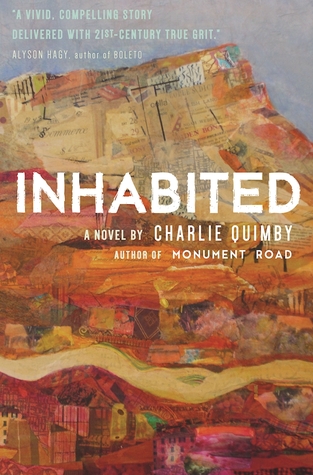
Inhabited by Charlie Quimby

Inhabited by Charlie Quimby

Inhabited is a book that looks at the spaces in our lives that we inhabit.  We each have a space we call home, it could be you live in a big house, or a apartment or in a tent by a winding river. Each of us needs shelter and dignity.

Inhabited tells the intersecting stories of a Colorado real estate agent who has many personal struggles living in Grand Valley and the homeless population. She must deal with the grief on the death of her sister and marriage and the homeless population who clash with the community as they look for a place to call their own. Inhabited is very well researched and the issues surrounding the homeless will educate the reader.  I learned so much.

Quimby is a beautiful writer. His words evoke a beautiful landscape of poetic prose.  Inhabited is a book to savor, to read slowly and enjoy the language.

Go beyond the book with these links:

An Interview with Charlie Quimby:  http://www.rubiconline.com/qa-book-fest-author-charlie-quimby-talks-about-newest-book-monument-road/

Book Review by the Star Tribune in Mpls.:  http://www.startribune.com/reviews-inhabited-by-charlie-quimby-and-a-house-without-windows-by-nadia-hashimi/396353461/

Kirkus review:  https://www.kirkusreviews.com/book-reviews/charlie-quimby/inhabited-quimbly/

National Alliance to End Homelessness:  http://www.endhomelessness.org/

Avenues for Youth:  I teach in Mpls and have students who are homeless and this organization helps homeless teens in my area.  6000 homeless every night.  http://avenuesforyouth.org/
INHABITED, a novel by Charlie Quimby from Torrey House Press on Vimeo.


Saturday, March 18, 2017

Interview with Su Smallen + Giveaways

Interview with Su Smallen + Giveaways

Su Smallen is the Minnesota Author in the Spotlight for the month of February and I had a chance to interview her about her two amazing books of poetry.  Read on to learn more about Su, her writing practice and her books of poetry.

Hello Su,

1. Please tell us a little bit about yourself?

I’m named after the flower rudbeckia, in the sunflower family, which my parents call brown-eyed susan. I would love to live in a yellow house and grow a garden of sunflowers.

2. What is the inspiration behind Kinds of Snow?

We experienced several years with little snow in Minnesota, relative to previous decades, and I missed it. I wrote to imaginatively call forth snow, and while doing so, snow called forth me.

3. What is the inspiration behind You This Close?

I was awarded a residency with the Science Museum of Minnesota’s St. Croix Watershed Research Station, which included the opportunity to learn from the scientists there about the river and its watershed. This gave me images and language for writing poems to a beloved I have not yet met.

4. Why did you become an author of poetry?

I come from quiet people who pay attention to small things. I am attuned to language, space, and light.

5. Where do you find your inspiration?

Nature, poetry, visual art, performance art, and the necessity of connection.

6. Do you read?  What books or author/poets inspire you?

Yes and never enough. I have studied Virginia Woolf half my life, she constantly evolved herself. Woolf saw through things; she focused the inner life within the outer life.

7. You’ve written and published several books of poetry.  Tell us a little bit about your other books.

Buddha, Proof was first published as an artist book, hand-stitched with original art by broadcraft press. The book became a Minnesota Book Award Finalist and quickly sold out of two printings; it was then picked up by a small press for traditional, perfect-bound publication of a new edition that includes more poems. Buddha, Proof is a seriously light-hearted portrayal of Buddha in the United States.

Wild Hush was also published as a hand-bound book with original art by Susan Solomon. It is about many kinds of silence.

Weight of Light is my first book, and I am excited to tell you that it has been picked up by a new publisher after being out of print for ten years. I don’t have a publication date for it yet, but perhaps late 2018.

8. How do you carve time out of your busy day to write?  Are you a full time writer or do you have a day job? What is one of your daily writing rituals or habits?

Yes, my day job as a science editor is impossible, and work days are too long and draining. During the week, I jot things down when they occur to me. Sometimes these are cryptic notes like "red-handled can opener" that I hope will be enough to remind me later what I was thinking. Also during the week I write for 20-30 minutes twice per day: when I wake and before sleep. Then, during the weekend, I set aside quite a bit of Sunday for writing, using my week's reading and writing notes.

9. Usually poetry is autobiographical and personal. Is it hard to share your personal memories and experiences with the world? Why do you do it?

By the time a poem is published, it has "grown up"; I have revised it, sought and considered feedback, tested its reception during poetry readings.  Along the way, the poem becomes its own being, separate from me. I write them to wonder, to connect, and to give.

10. In one sentence, tell readers why they should read Kinds of Snow.

Snow, because it conceals and reveals, can help you make your way, “from point A to point A.”

11. In one sentence, tell readers why they should read You This Close.

If you seek your soulmate, if you know your soulmate, or if your soul loves a river, these poems will resonate with you.

Thanks Su!

If you want to win a copy of Su's books enter here:

Kinds of Snow Giveaway
You This Close Giveaway


Saturday, February 25, 2017

Su Smallen Guest Post + Giveaways


Su Smallen Guest Post + Giveaways

Su Smallen is the Minnesota Author in the Spotlight here on Booksnob for the month of February and she has written her first blog guest post and it is wonderful.  READ ON!


Writing to Get a Grip
by Su Smallen

Recently, I visited the Rural America Writers Center in Plainview, Minnesota, and was asked, do I imagine an audience when I write. On the formal level, I do, but without knowing who my audience will really be. On the mysterious level—why I turn and return to writing rather than cooking or sculpting—I write to a better self, the one I wish to call forward, know better, be with more often. The self that knows how this will all turn out.

Maybe that’s why it is difficult to write now. I confessed to the Rural America Writers that I have not been able to write anything coherent since the election. Sometimes I avoid the page entirely. I am scared for the self that knows the future—she is much more than my future self, or yours, this self that knows the future of the earth and her every being. I am not convinced that any of my words can save the planet. They are not political reasoning, not rule of law; they do not step down an economy of oil, cocaine, and human trafficking.

Poetry steps into an economy of notice and empathy. Maybe “an economy” is not the right fit with poetry, although the word does have in its roots “stewardship of the dwelling.” Poetry’s economy is a system that runs largely unseen and outside of the political environment, like so much else, like the cycles of carbon, hydrogen, and oxygen, like the cycles of kindness and civility. Against the annihilation of such “unseen,” my words are microscopic, meaning minuscule, and also microscopic, meaning magnifying enough to be seen.

What should be seen? Who? We are too many people; we can’t agree, can’t collectively prioritize—no one wants to be left for later. What if there is no later? Our dissonance is jamming clarity. I feel this inhibiting tension inside and out. It feels like receiving all 44,000 radio stations without a selecting tuner.

But writing microscopically, on a private scale, builds for my receiver a tuner. Word by word the tuner tunes as I trust the paper and the ink, as I trust the shapes we have agreed to for letters that make comprehensible code, scalable code. What can a particular moment hold? Or three breaths? Think what four letters can hold: hood, rain, wren, ruin, fuse, port, soil, grip.

Grip holds in its etymology “handful, sheaf.” Sheaves of paper. “Get a grip,” Deborah Keenan says
when writers stall.

I forgot how Carolyn Bizien, one of the Rural America Writers, phrased her question with exacting beauty. Do your poems hold your past for you, do they help you now, was that the gist of her question? It led to my confessing a recent rough spell, during which my poems kept a grip on me, gave my words back when I needed them, with accumulated meaning. Which is how all poems work, when they work. Poems work similarly to your patient spouse who suggests and hints and states outright a hundred times until one day you say, I have an idea, and it was hers all along.

Does poetry still matter in these times? The Rural Arts Writers assured me it is, by their words and their presence. Each writer that night had come for miles—30, 50, 60 miles—to pay attention. Their receptiveness, each attendant a tuner, assured me. As I have been writing this small essay, my breath has deepened and steadied. Unhelpful thoughts moved aside. The secret 3am bird sang and fell silent. There is more room in the room.

Thanks Su!

If you would like to win a copy of one of Su's wonderful poetry books please enter here:
Kinds of Snow Giveaway
You This Close Giveaway


Tuesday, February 21, 2017

You This Close Giveaway

You This Close Giveaway

Su Smallen is the Minnesota Author in the Spotlight for the month of February and she is giving away 5 copies of her beautiful book of poems to lucky Booksnob followers.  Su writes beautifully and you will love, You This Close.

Here is the synopsis from Goodreads:

Poetry. llustrations by Jessica Zeglin. YOU THIS CLOSE is a rippling work encompassing love and water, longing and the natural world. Su Smallen wrote these poems during a residency with the St. Croix Watershed Research Station, where she learned about aquifers and diatoms from the scientists there, kindred in their curiosity about the elegant ways nature works. With imagery from the river and its creatures, the poems of YOU THIS CLOSE are linked together with the last line of one becoming the first line of the next, making a structure that matches a kind of diatom chain. The poems are also about hope for love, addressing a beloved not yet met.

Giveaway Rules:
Fill out the Form
Must be a Booksnob follower
Open Internationally
Ends March 21st at midnight
Good Luck!

a Rafflecopter giveaway


Monday, February 13, 2017

Charlie Quimby Author Interview + Giveaway

Charlie Quimby Author Interview + Giveaway

Charlie is the Minnesota Author in the Spotlight for the month of January and he has graciously agreed to answer some questions about this writing life and career, his favorite books and authors and so much more.  I hope you read on to discover more about this interesting author and his books Inhabited and Monument Road.

Hi Charlie,

1. Tell us a little bit about yourself.

I was born in Western Colorado and got away as soon as I could because I didn’t see a future for myself there as a writer. I went to Carleton College and have lived in Minnesota since, always making my living from writing, with a few odd jobs thrown in during those early days of selling book, music and theater reviews for $25 apiece.

Since then, I’ve had a historical play commissioned, worked in corporate communications, founded (and retired from) a marketing communications agency, taught information design, written about community planning, transportation, education and tax policy, helped nonprofits raise capital, kept a blog going for a dozen years and published two novels.

For the last decade, I’ve gone back to writing full-time versus running a business. This allows me the freedom to still live in Minnesota but spend the winters (and the disappointing part of spring) in Colorado.

Maybe best of all, I’m still married to the woman I first met at Carleton back in 1968.

2. What is the inspiration behind Inhabited?

For eight years I’ve volunteered for organizations that serve homeless people in Minneapolis and Grand Junction. Being granted access to the lives of the very poor in America inspired me to share what I’ve learned—not just about the conditions of homelessness but about the ways the rest of us
accept, explain or ignore severe poverty and dysfunction in our country.

Also, the culture, landscape and struggles of the hometown I fled are essential to the stories I tell. As a relatively isolated western community with an ambition to do more than tumble through boom-and-bust cycles, Grand Junction shrinks down to size the challenges facing many American cities.

The types of conflicts that arise in the novel are real everywhere. But writing about them in the country where I grew up takes me to my “bone place”—where emotion and sense of time are deep and palpable.

3. Tell us about your first book, Monument Road. How do Inhabited and Monument Road connect?

Both books are set in the Grand Valley and both concern how people survive grievous loss and its accompanying regret.

Monument Road focuses on a seventy-something rancher who has spent the year after his wife’s death preparing to fulfill a promise to her—and to end his life at the same time. Leonard Self is a decent but taciturn type who appreciates too late how much of the world he had walled off with his rectitude. His story intertwines with two young people who died along the road he will travel on his final day. One, a foster boy who once lived with Leonard and his wife. Another, a high school girl named Helen whose passionate nature took her too close to the edge.

Memories and encounters on his drive seem like obstacles but they may also be signs redemption waits at the end of the road.

Inhabited continues a theme that runs through Monument Road—how being at home involves feeling comfortable in a place, a set of a relationships and in one’s own skin. It also picks up a loose thread related to Helen’s death in Monument Road.
Inhabited is primarily the story of Meg, Helen’s sister. A successful realtor, Meg's involved with good causes, including serving on the town’s homeless coalition and bringing a promising development to town, and she helps homebuyers find the “lifestyle of their dreams.” But she carries an unresolved guilt that keeps her from fully being herself and from being intimately known by others.
And then she encounters a homeless man named Isaac, whose decency shines through his life's disrepair and whose desire for order could unmask Meg’s carefully constructed image.

4. Usually an author includes some of their life experiences in their books. Did you do that?  Do you have anything in common with your characters?

It’s inevitable that something of a writer’s nature ends up in the blender. For example, in both books characters arrive at perilous heights, which reflects my real-life experience of being drawn and repelled by such places.

I write about the country where I grew up but it’s more as an observer than as a participant. My father took his life in 1984, a period when the community hit bottom economically. Every suicide reflects, in a sense, the sufferer’s distorted view of oneself and poses a mystery that can never be solved. There’s nothing like my father’s death in my novels, but I’m sure my deeper themes flow in part from his life.

I hate characters who are the author in costume. In the few instances where I tried that, I either stopped writing or shrank the guy and moved him away from the center of the story. I already knew him and he wasn’t able to surprise me.

Unfamiliar characters and situations force me to go somewhere new or fearsome, to employ empathy more than memory. That’s what I find stimulating as a writer and as a reader. So I’ve written about an agnostic rancher and his very Christian wife, adventurous high school girls, homeless people with mental illness, a man in denial that he’s a serial killer, an enterprising nun, an alcoholic who finds his center late in life, a semi-redneck businessman, etc.

5. What are some of the issues in Inhabited that are integral to your story?

Your question makes me want to get on my soapbox, something I tried hard avoid in the book itself. I’ll just say the story’s focus on homelessness and economic development invites people of good will to ask themselves some fundamental questions about self-interest versus the interests of others.

For example, last night a book club reader identified a key question in the story: whether it’s possible to distinguish the “undeserving” homeless in order to help only the “deserving.”

Are economic outcomes the proper measure of mankind? Is wealth truly virtue’s reward, and if so, what does that say about the poor? Should we leave society’s toughest problems up to the market since diverse communities can’t seem to agree on solutions?

We tend to judge other human beings based largely upon how alike they are to us. That’s the core issue in Inhabited and at the center of our national discourse.

6. Do you like to read?  What are some of your favorite books and authors?

Reading is an essential part of the writing life. I tend to look for a book that is right for me at a particular moment, rather than pursue greats or favorites, because what concerns and influences me changes.

Life is short and even Pantheons go out of date. For example, writers as different as Edmund Wilson, Harry Crews, Wright Morris and Margaret Atwood once inspired me to acquire all their works. I still haven’t read all of them.

Not to totally dodge the question, here are some of my all-time favorite reading experiences. All of George Orwell, including the four-volume Collected Essays, Journalism and Letters. Loren Eiseley, an anthropologist and natural science writer, especially The Immense Journey and The Night Country. Wallace Stegner for his writing about the culture, history and environment of the west. And Joe Sacco for his use of the graphic novel form to give an intimate focus to the big subject of war.

7. What is one book that you think should be part of the school curriculum or a part of the great books canon?

1984 should be taught forever. Unlike many books in the canon, people will read it anyway.

8. How do you carve time out of your busy day to write?  Do you write full-time or do you also have a “day” job?

I have always written full-time, though only in the last seven years as a writer of fiction. I am very fortunate to have reached a point in life where my livelihood does not depend on being a novelist.

My first move each day is to fill my coffee cup and sit down to work on something—a novel-in-progress, a blog post, a letter to the editor. I don’t set goals or deadlines, such as words per day or number of hours. If I hit my desk and don’t write anything, that’s very unusual, but I don’t beat myself up over it because I’ll be back at it tomorrow.

9. Have you begun working on a new book?  Can you tell us about it?

I’m in the early stages of working on a third novel that is also set in Western Colorado. The story centers on a very wealthy patriarch who has made his fortune by exploiting the earth and is now building a trophy retreat in the mountains that he hopes will cement his legacy. I expect a lot will go wrong with his plan.

10. In one sentence tell readers why they should read Inhabited.

Inhabited will open your eyes to strangers, tune your ear to their voices, and perhaps change your mind about the boundaries of kinship and the meaning of home.

Thanks Charlie!!

If you would like to win a copy of Charlie's book Inhabited please enter here:  Inhabited Giveaway


Friday, February 10, 2017

Charlie Quimby Guest Post + Giveaway

Charlie Quimby Guest Post + Giveaway

Charlie is the Minnesota Author of the month for January and he has written a guest post about homelessness.  He volunteers at a family shelter and his latest book, Inhabited, does a great job covering many of the issues surrounding homelessness.  Read on to learn more.


Since 2009 I’ve been a volunteer with organizations serving people who are unsheltered or in danger of slipping back into homelessness. In the process, I’ve met hundreds of homeless adults and children in two states.

My blog reports stories and observations from this involvement, but it’s limited in scope. To explore homelessness in a larger social context, inside minds and away from the shelters, I turned to fiction.

My novel Inhabited follows two characters whose lives become disrupted by a developer’s proposal to transform a boom-and-bust Colorado town. The plans to reclaim a forsaken riverfront dislodge a homeless camp, sending an unstable man in search of shelter and unsettling an upscale realtor’s seemingly perfect life. The book asks readers to consider the border between doing the right thing for yourself or for others.

Since Inhabited came out last fall, some readers have told me: “I’m not sure I want to read that much about homelessness.”

Maybe I shouldn’t be surprised.

The term “homelessness” pushes a shopping cart full of stereotypes. The insistent panhandler. The pathetic
bag lady. The unclean dumpster diver. The vocal paranoid.

This visible presence of the poor in our communities challenges our assumptions about society’s safety net and our own compassion and generosity.

We tend to look away from such figures on the street, and in popular entertainment, view them through the comforting filter of stereotypes, where they deliver comedy, menace or pathos in walk-on roles. They appear as anonymous victims of serial killers and wilding teens. They share scraps with pigeons and sleep in cardboard squalor. They are scary and dangerous or noble and wise. They are fallen angels or agents of redemption.

Rarely are they presented as fully realized human beings, so these stereotypes reinforce our distanced perceptions.

We know that reading literature encourages empathy. Fiction grants a safe entre to the perceptions and experiences of others and helps us appreciate people very different from ourselves.

A novel doesn’t have to be “about homelessness” to illuminate some of its many dimensions. Consider the rebels and wanderers in Huckleberry Finn, On the Road, Train Dreams, American Rust and The Unnamed. Their protagonists seek independence, fun, meaning, justice and healing—all essential pursuits of the uprooted in America.

In dystopian novels, entire populations are upended by catastrophe. Wiping out the old rules and systems dampens personal culpability for being down-and-out and casts light on the importance of society. Characters in The Road, Station Eleven and The Dog Stars must toil individually, question morality and try to reestablish community. These are also very real struggles of homeless individuals.

It can be revealing to see how people who share a place experience it very differently. A key reality of homeless life is the sense of exclusion from the mainstream, of being simultaneously untouchable, unworthy and dangerous. In Inhabited, they are compared to the invasive tamarisk that has overgrown the riverbank.

A venerable strain of American literature shows readers the economic, social, family and personal dimensions of poverty’s shadow world. Think of John Steinbeck’s The Grapes of Wrath, William Kennedy’s Ironweed, Colum McCann’s This Side of Brightness, Russell Banks’ The Lost Memory of Skin, Peter Hoffmeister’s Graphic the Valley, Jess Walter’s We Live in Water and Smith Henderson’s Fourth of July Creek.

Non-fiction offers other, safe ways into places we might fear. Big city shelters (Jonathan Kozol’s Rachel and Her Children and Nick Flynn’s Another Bullshit Night in Suck City); fragile families (the Jeannette Walls memoir The Glass Castle); mental illness on Skid Row (Steve Lopez’s The Soloist); and the conscious rejection of material culture (Mark Sundeen’s The Man Who Quit Money).

Exposure to such lives has made me less judgmental and more attuned to my privilege. Most acutely, I’m aware that what we define as a struggle between right and wrong most often plays out in choices between self and others.


Thanks Charlie!
You can visit Charlie's blog at http://greatdivide.typepad.com/

Enter to win a copy of Charlie's book, Inhabited here:  Inhabited Giveaway


Friday, February 3, 2017

Announcing the February Author in the Spotlight.

Announcing the February Author in the Spotlight.

Oh Yeah!  Happy February.
The groundhog is in the house,
love is in the air and
there are a lot of really good
books out there.

Bam. I made a short poem rhyme.  Can you tell I'm feeling silly?

Let me add that this month, on Sunday, Feb 5th, marks my blogging anniversary and I have been blogging for a full 7 years.  Crazy!!

Plus I have been featuring amazing Minnesota Authors on Booksnob for 6 and a half years now, that is like 12 authors a month for over 6 years which equals= a LOT of authors.  And there are so many MN authors I love and met through writing this blog and so many authors from Minnesota that I haven't read yet.

This month's author is Su Smallen.  She is an amazing poet with two new books out by two different presses and you are going to love them.

Here are the synopsis from Goodreads:

Kinds of Snow

Nature provides the lexicon of de Kooning Snow. The poems inde Kooning Snow negotiate many kinds of loss, metaphorically represented as kinds of snow. Classifications of snow, such as prisms, cups, columns, dendrites, and scrolls, mark places among the poems as when, in a weaving, the warp becomes visible. The title poem frames presence, meaning, memory, and erasure. Several of the poems are contained in panels like Rauschenberg sWhite Paintings. As the poem Glacier reflects, the arc of the book is lyrical rather than narrative, from point A to point A, no point at all. The poem The Last of placed second for the Joy Harjo Poetry Award judged by Dorianne Laux. Three of the poems have been nominated for a Pushcart Prize; ten have been anthologized.

You This Close

Poetry. illustrations by Jessica Zeglin. YOU THIS CLOSE is a rippling work encompassing love and water, longing and the natural world. Su Smallen wrote these poems during a residency with the St. Croix Watershed Research Station, where she learned about aquifers and diatoms from the scientists there, kindred in their curiosity about the elegant ways nature works. With imagery from the river and its creatures, the poems of YOU THIS CLOSE are linked together with the last line of one becoming the first line of the next, making a structure that matches a kind of diatom chain. The poems are also about hope for love, addressing a beloved not yet met.


This month you can expect a book review, a giveaway, an author interview and hopefully a guest post.

You can find Su Smallen on her website at https://susmallen.com/

Happy Reading!!


Tuesday, January 3, 2017

Announcing the January Author in the Spotlight

Announcing the January Author in the Spotlight

Happy January and Happy 2017.
I hope you have had a good start to the year.
Right now it is bitter cold in Minnesota with a negative 40 degree windchill and a below zero temp. Perfect for curling up under a blanket and reading a good book.

I've started a goal of doing 10 minutes of yoga everyday this year and I'm also plan to write once a day all year and I started a temperature rug where I add a strip of color based on the temps for everyday of the year.  I have a lot more goals including reading a book by January's Minnesota Author in the Spotlight, Charlie Quimby.

Charlie Quimby has written two novels, Monument Road and his newest book, Inhabited and both take place in Colorado.

Here is the synopsis from Goodreads:

Monument Road
Leonard Self has spent a year unwinding his ranch, paying down debts, and fending off the darkening. Just one thing left: taking his wife's ashes to her favorite overlook, where he plans to step off the cliff with her into a stark and beautiful landscape. But Leonard finds he has company on a route that intertwines old wounds and new insights that make him question whether his life is over after all.

Inhabited

Meg Mogrin sells pricey houses, belongs to the mayor's inner circle, and knows more than she's letting on about her sister's death. Isaac Samson lives in a tent and believes Thomas Edison invented the Reagan presidency. When their town attracts a game-changing development, Isaac is displaced by the town's crackdown on vagrancy. As Isaac struggles to regain stability, Meg contends with conflicting roles of assisting the developer while serving on the homeless coalition. Isaac's quest to return a lost artifact soon intrudes into Meg's tidy world, digging up a part of her past she'd rather remained buried. Inhabited, a sister novel to Charlie Quimby's acclaimed Monument Road, returns to the Grand Valley of western Colorado to explore the dimensions of loss, the boundaries of compassion, and the endurance of love.

This month you can expect a book review, an author interview, a giveaway and a guest post.
You can find Charlie and information about his books and his blog on his website at www.charliequimby.com

Happy Reading and Happy New Year!


Wednesday, December 28, 2016

In Winter's Kitchen by Beth Dooley

In Winter's Kitchen.
Growing Roots and Breaking Bread in the Northern Heartland
by Beth Dooley

Books and Food go together well.  In fact, they are two of my favorite things so I was thrilled to get a chance to read this book.  I adored, In Winter's Kitchen and read it slowly, one chapter at a time, to savor it.  Each chapter is about a particular food that thrives in the Midwest, like apples, wheat, potatoes, cranberries, corn, wild rice, turkey and many more.  Beth writes about her family and meets with local farmers at the farmers market and even meets them at their farms.  She talks about conventional food and organic and details the path from farm to table.  Beth connects our love of food with our love of family and love of the land. She reminded me that buying food is making a choice for a better world and a healthy body which is very important to me since I have a food allergy to corn and most canned, packaged store bought food contains some form of corn. So I have to make most of my families meals from scratch everyday.  In Winter's Kitchen has taught me so much about the food I eat and the companies I buy from.

In Winter's Kitchen is part memoir, part food history and part midwest guidebook with really good recipes tucked inside.  There is one recipe per food chapter so for example the Apples chapter has a recipe for applesauce, which I made and it was delicious. This is the first time I made homemade applesauce and it was super easy and super good.  I haven't eaten applesauce in years. Here is a picture.

This is a great book to read this winter.  Read it and then make some great food.
In Winter's Kitchen was a finalist for the Minnesota Book Award in 2016.

Here are some links to help further your reading experience.

Visit Beth at her website where you will find lots of information and delicious recipes
http://www.bethdooleyskitchen.com/

Listen to Beth on the Splendid Table podcast.
https://www.splendidtable.org/story/beth-dooley-on-the-joy-of-cooking-and-the-future-of-wheat

Gardens, Kitchens and the Great Midwest.  U of MN episode of Read This Book features Beth Dooley and another of my favorite authors Ryan Stradal.
https://youtu.be/_pLrg10D-Lc

Listen to this story from MPR which includes two recipes from the book.
http://www.mprnews.org/story/2015/11/18/books-appetites-beth-dooley

An awesome book review from Heavy Table
http://heavytable.com/in-winters-kitchen-by-beth-dooley/


Friday, December 2, 2016

Beth Dooley Guest Post + Giveaway

Beth Dooley Guest Post + Giveaway

Beth Dooley is the November, Minnesota Author in the Spotlight here on Booksnob. She is a foodie and has written several cookbooks and she has written a guest post about two books she could not live without.
Read on to find out more.

Tender: A Cook and His Vegetable Patch and Ripe: A Cook in the Orchard, by Nigel Slater (Ten Speed Press)

If my kitchen caught fire, Nigel Slater’s two volumes – Tender and Ripe – are the books I’d grab exiting the backdoor. These hefty, beautiful volumes are written in a quiet and deeply personal voice, and the prose is as sumptuous as are his recipes. The photos alone are worth the price. In each short chapter, Slater relays, in great detail, the pleasure he takes in tending the small garden of his London home. He shares memories, a little food history, and provides practical information about planting and harvesting the vegetables and fruits. As he moves into the kitchen, his advice is whimsical and engaging with suggestions for flavor pairings, quick preparation tips, and simple, homey recipes.
Never self-righteous or preachy, Slater’s love of our earth’s bounty and it’s benefit to our health and environmental shine through. His ascetic is comforting and inspiring and these pages transport me to
a gentler time and more civilized place.

If you would like to enter to win a copy of Beth's book, In Winter's Kitchen please click here:

In Winter's Kitchen

Good Luck!

Thanks Beth!

Friday, November 18, 2016

The Firebug of Balrog County by David Oppegaard

The Firebug of Balrog County by David Oppegaard

I'm in love with a firebug. David Oppegaard's novel is set in a fictional small town in Minnesota. The main character is a high school senior named Mack who is grieving the loss of his mother to cancer. He feels the need to start fires and at first he starts out small but then things spiral out of control quickly like a rapid burning flame.  Mack has a great family and a interesting set of grandparents, all who are wounded and grieving. His grandpa is the mayor who is trying to catch the culprit who is setting fires and begins a cat and mouse game between the two of them.

The Firebug of Balrog County is a well-written novel that was a finalist for the Minnesota Book Award in 2016.  The story is told in short chapter bursts and full of wry wit and angsty humor.  You will fall in love with the main character and his family and even the small town. I was laughing and crying and rooting for Mack with all my heart.  Mack is charming and quirky and never been kissed and in desperate need of a girlfriend. In some ways Mack reminds me of Duckie form Pretty in Pink and David Oppegaard reminds me of a modern John Hughes.

The Firebug of Balrog County needs to get into the hands of teenage boys.
I would pair The Firebug with A.S. King's- Everybody Sees the Ants.


Go Beyond the book with this link:

Listen to a 4 min interview on Minnesota Public Radio of author, David Oppegaard.
https://www.mprnews.org/story/2015/10/01/books-thread-david-oppegaard


Thursday, November 10, 2016

David Oppegaard Author Interview + Giveaway


Author Interview with David Oppegaard + Giveaway

David is the Minnesota Author in the Spotlight here on Booksnob for the month of October. I had a chance to ask him some questions about his Young Adult novel, The Firebug of Balrog County.  I want you to know that I'm in love with the firebug.  Read on to find out more from David about his inspiration, what he's reading right now and what he recommends to read post election.  Enjoy.

1. Tell us a little bit about yourself.

I live in St. Paul with my cat, Frenchie. I’ve wanted to be a writer since I was about seven years old, when I started writing little stories about aliens and ninjas. I’ve published four novels but I’ve actually written sixteen, going on seventeen. I write in multiple genres including horror, fantasy, sci-fi, and literary. Most things I do are motivated by an urge to A) feel like I earned the whiskey, beer, and cheese I consume and B) not be bored.

2. What is the inspiration behind The Firebug of Balrog County?

My mother passed away from complications related to cancer in October of 2000. Firebug is my attempt to address that loss and come to terms with it while using a proper balance of humor and swear words. It didn’t take long to actually sit down and write because the mental process behind it took thirteen years.

3. Usually an author puts some of his own life experiences in the book.  Did you do that in
Firebug?  Do you have anything in common with your characters?

Autobiography is all over FIREBUG. The setting, the story of the mother. The cranky war vet mayor. The main character, Mack, is a lot like an eighteen-year-old version of myself, except I was never that into starting fires and was generally law abiding.

4.  Can you tell us about your previous books?

I‘ll stick to the published titles: The Suicide Collectors is post-apocalyptic speculative fiction about a suicide plague and a group of survivors searching for a cure. It was nominated for a Bram Stoker Award and blurbed by Stan Lee. Wormwood, Nevada is about a meteorite upending a small Nevada town and the lives of its citizens. And the Hills Opened Up is an old-school horror-western about a copper mining town that’s set upon by a murderous creature called The Charred Man.

5.  Do you like to read?  What are some of your favorite books and authors?

I’m always churning over a stack of books on my night stand. I’m a big fan of Fyodor Dostoyevsky’s complete works and Don Quixote. Right now I’m reading Mindy Kaling’s amusing autobiography Is Everyone Hanging Out Without Me?.

6.  Name one book that you think is a must read for everyone and tell us why?
Post-election, I suppose I’d choose 1984 by George Orwell or Fahrenheit 451 by Ray Bradbury for their frightening portrayal of oppressive regimes opposed to knowledge, though I guess the fat orange cat’s out of the bag now, isn’t it?

7.  How do you carve time out of your busy day to write?  Do you write full-time or do you also have a “day” job?
I work full time at the University of Minnesota as a staff member. I take a nap when I get home, make dinner, go for a run, then I usually write from 9-11 PM.

8.  Did you choose the title and cover for the book?  How did you come up with Balrog County?  Is it the name of a real place?

The title is mine and I was given two covers to choose from as well as feedback on the color scheme. Lisa Novak was the cover designer and she did a smashing job. Best cover ever.
Balrog County is a vague allusion to Blue Earth County in MN, though the book could be set in any Midwestern state.

9.  Have you begun working on a new book?  Can you tell us about it?
Since FIREBUG came out I’ve been working on three books. The newest one still in progress is called SUNDOWNING. It’s about a retired rancher in Montana and his family as they deal with the rancher succumbing to Alzheimer’s.

10.  In one sentence tell readers why they should read, The Firebug of Balrog County?
It’s funny as hell and there’s a dog in it named Chompy.

Thanks, David!!

If you want to win one of three copies of his book The Firebug of Balrog County, click here;
The Firebug of Balrog County Giveaway

You can find David on his website at:  https://davidoppegaard.com/